The maintenance philosophy where operators stop saying "that's not my job" and breakdowns stop being normal
Every workplace runs its own version of the same experiment. On a factory floor, a machine starts making a strange noise on Tuesday; the operator shrugs and keeps the job running, because reporting equipment problems is the maintenance department's territory. By Friday the spindle seizes and the line stops for two days. In an office the props change but the script doesn't: the meeting-room projector has been flickering for a month, everyone has quietly learned to tap it twice, and it finally dies five minutes before a client demo. In both places, everyone acts surprised.
Total Productive Maintenance exists to kill this script. It doesn't do it with more technicians or a bigger spare-parts budget. It changes who owns equipment health in the first place.
What Is Total Productive Maintenance?
Total Productive Maintenance (TPM) is a maintenance strategy in which every employee, from machine operators to managers to office staff, shares responsibility for keeping equipment in optimal working condition. The goal is deliberately extreme: zero breakdowns, zero defects, and zero accidents.
The word that matters most in the name is total. Traditional maintenance is a department. TPM is a company-wide operating culture where the person running the machine does the daily cleaning, inspection, and lubrication, while skilled technicians focus on planned work, overhauls, and improvements.
The logic is practical. The operator spends eight hours a day next to the equipment and notices the new vibration or the small oil leak weeks before a scheduled inspection would catch it. TPM turns that proximity into the cheapest failure-detection system you can get.
Where TPM Came From
TPM has a specific birthplace. In 1971, Nippondenso (now Denso, a major Toyota supplier) formalized the approach under the guidance of Seiichi Nakajima, who is generally credited as the father of TPM. The Japan Institute of Plant Maintenance (JIPM) still maintains the methodology and audits plants for the TPM Excellence Award, which remains the de-facto certification standard.
The idea spread alongside lean manufacturing for a simple reason: you can't run just-in-time production with machines that break down unpredictably. That's why the U.S. EPA lists TPM as a core lean method. Stable equipment is the precondition for everything else lean tries to do.
TPM vs Preventive Maintenance: Not the Same Thing
People use these terms interchangeably, and it causes real confusion when they go shopping for software or training. The distinction:
| Reactive ("run to failure") | Preventive maintenance | Total Productive Maintenance | |
|---|---|---|---|
| Who maintains equipment | Maintenance dept, after failure | Maintenance dept, on schedule | Everyone, continuously |
| Trigger | Breakdown | Calendar or usage interval | Daily operator care + planned work + improvement projects |
| Scope | Repair | Servicing tasks | Culture, metrics, training, design feedback |
| Goal | Restore operation | Fewer failures | Zero losses of any kind |
Preventive maintenance is a task discipline. TPM is a management system that contains preventive maintenance as one of its pillars, alongside operator ownership and continuous improvement. If you already run PM schedules and still fight recurring breakdowns, the missing piece is usually the rest of the TPM structure, not more PMs.
The Foundation: 5S
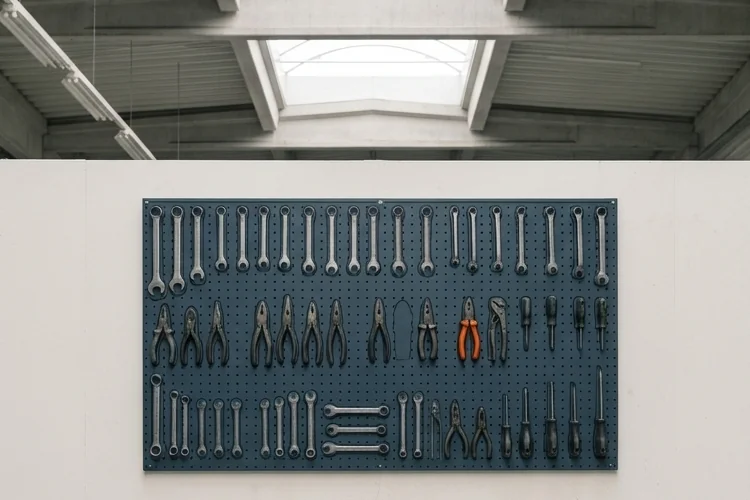
Classic TPM diagrams draw the methodology as a temple: eight pillars standing on a 5S foundation. The foundation isn't decorative. 5S (Sort, Set in order, Shine, Standardize, Sustain) is what makes problems visible. On a clean, organized machine, a fresh oil spot or a missing bolt jumps out at you. On a dirty one, defects hide in plain sight for months.
Teams that skip 5S and jump straight to the pillars almost always stall: operators are asked to "inspect" equipment where nobody can tell normal grime from a symptom.
The 8 Pillars of TPM
Nakajima's original model had five pillars; JIPM later expanded it to the eight used today. (References to "five pillars of TPM" describe the 1970s version, not a different methodology.)
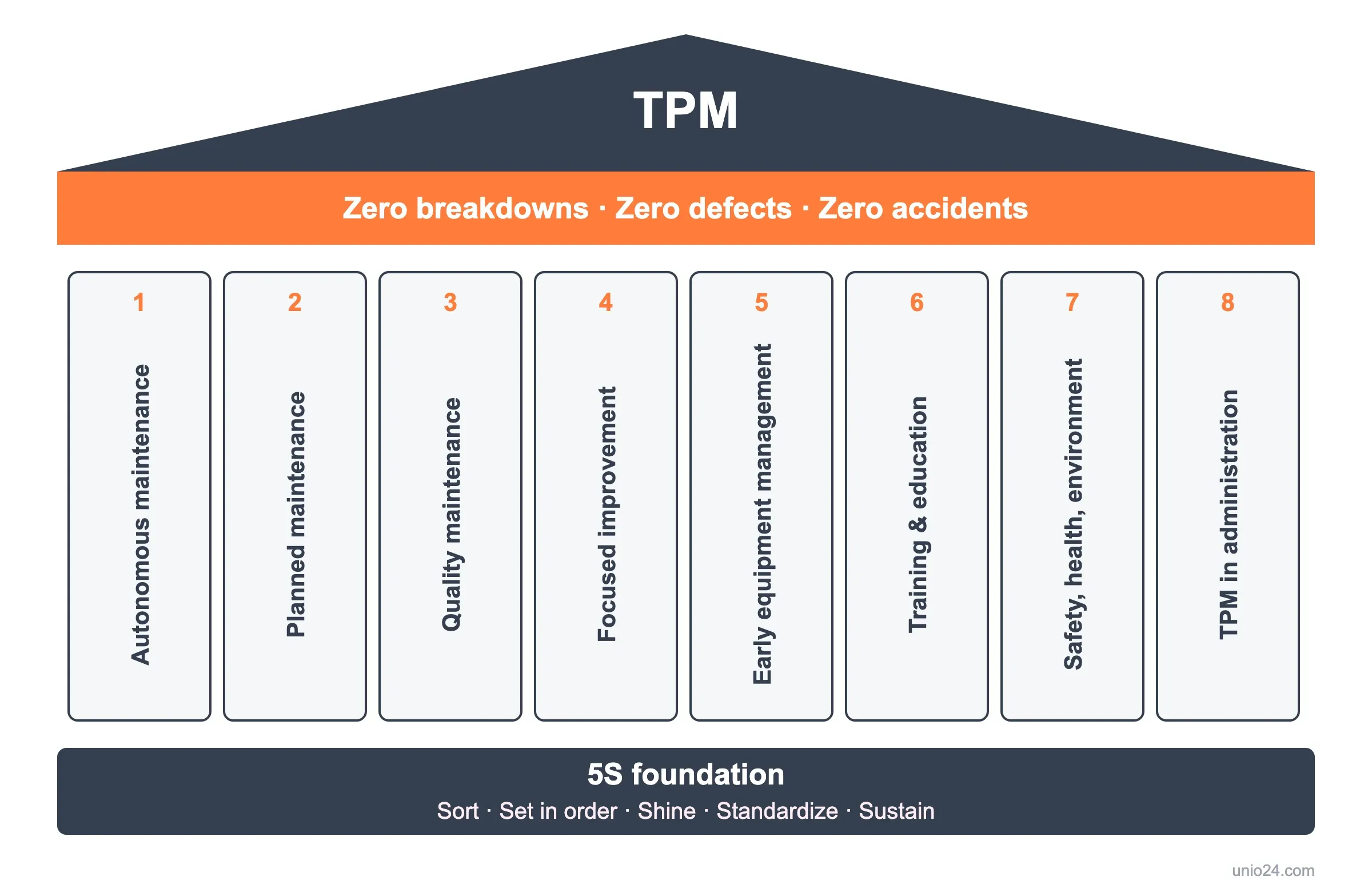
| # | Pillar | In one sentence |
|---|---|---|
| 1 | Autonomous maintenance (jishu hozen) | Operators handle cleaning, lubrication, and inspection of their own machines |
| 2 | Planned maintenance | Technicians schedule work based on failure data, not fire-fighting |
| 3 | Quality maintenance (hinshitsu hozen) | Detect and eliminate equipment conditions that create defects |
| 4 | Focused improvement (kobetsu kaizen) | Small cross-functional teams attack recurring losses one by one |
| 5 | Early equipment management | Feed maintenance experience into the purchase and design of new equipment |
| 6 | Training and education | Close the skill gaps that pillars 1–5 expose |
| 7 | Safety, health, environment | Zero accidents; a machine that's safe to maintain gets maintained |
| 8 | TPM in administration | Apply the same waste-elimination to order processing, procurement, scheduling |
Three of these decide whether the program survives, so they deserve a closer look.
Autonomous Maintenance: The Heart of TPM
This is the pillar that actually changes the culture. Operators take over routine care: daily cleaning (which doubles as inspection), lubrication, tightening, and simple anomaly checks, usually logged against a short visual checklist. Maintenance technicians stop burning hours on tasks an operator can do in five minutes, and start doing the skilled work only they can do.
You can guess the resistance in advance: "operators aren't qualified" from one side, "that's not what I'm paid for" from the other. The fix is boring: dead-simple checklists, real training, and management that visibly responds when an operator reports an anomaly. The first ignored report kills the program.
Planned Maintenance: Schedules Instead of Heroics
Once operators handle the daily layer, technicians move to interval- and condition-based work, the domain of preventive and predictive maintenance — collectively, pre-emptive maintenance. The inputs are failure history and metrics like MTBF and MTTR; the output is a schedule where components get replaced before their expected failure point, during planned windows instead of mid-shift.
This pillar is where software earns its keep. You can't schedule against failure data you never recorded, so a maintenance management system that keeps per-asset service history and fires work orders on schedule is the minimum infrastructure. Paper logs die within a quarter.
Early Equipment Management (the Pillar Everyone Skips)
Every maintenance team knows the machine that was designed by someone who clearly never had to service one. The grease fitting behind a guard panel held by fourteen bolts. Early equipment management routes what your team learned the hard way into procurement specs and acceptance criteria for the next purchase, so new equipment reaches stable operation in weeks instead of months. It's the least glamorous pillar, and across the whole asset lifecycle it's one of the highest-ROI ones.
How to Measure TPM: OEE and the Six Big Losses
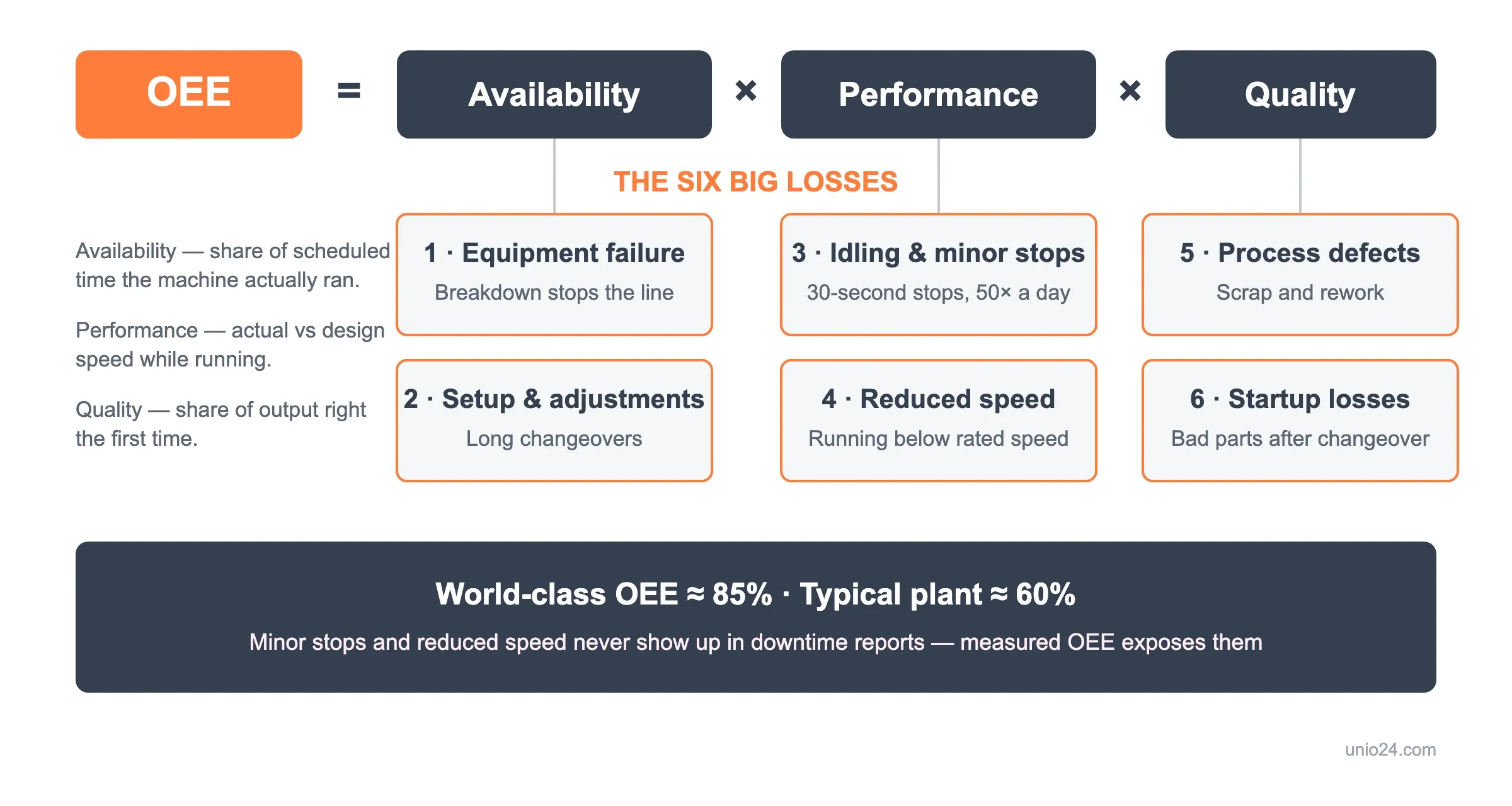
TPM without measurement is a poster on the wall. The standard metric is Overall Equipment Effectiveness (OEE):
OEE = Availability × Performance × Quality
- Availability: share of scheduled time the machine actually ran
- Performance: actual speed vs design speed while running
- Quality: share of output that was right the first time
An OEE of 85% is considered world-class for discrete manufacturing, while benchmark data collected by OEE.com puts the typical plant around 60% — and first-time measurements often land lower. The first honest number stings. That's the point. (For capacity decisions there's also TEEP, which measures against all 8,760 hours in a year rather than scheduled time.)
OEE's real value is that its three factors map directly onto the six big losses TPM sets out to eliminate:
| Loss | Eats into | Typical example |
|---|---|---|
| Equipment failure | Availability | Breakdown stops the line |
| Setup and adjustments | Availability | 40-minute changeover between products |
| Idling and minor stops | Performance | Sensor misread clears in 30 seconds, 50 times a day |
| Reduced speed | Performance | Machine runs at 80% of rated speed "because it jams otherwise" |
| Process defects | Quality | Scrap and rework during stable production |
| Startup losses | Quality | Bad parts produced while dialing in after changeover |
Minor stops and reduced speed are the sneaky ones. They never show up in downtime reports, because nobody logs a 30-second stop. Measured OEE exposes them.
How to Implement TPM: 12 Steps, 4 Phases
Nakajima's classic roadmap, laid out in his 1988 book Introduction to TPM (Productivity Press), has 12 steps. Here they are grouped into the four phases that matter, with an honest note on where programs die.
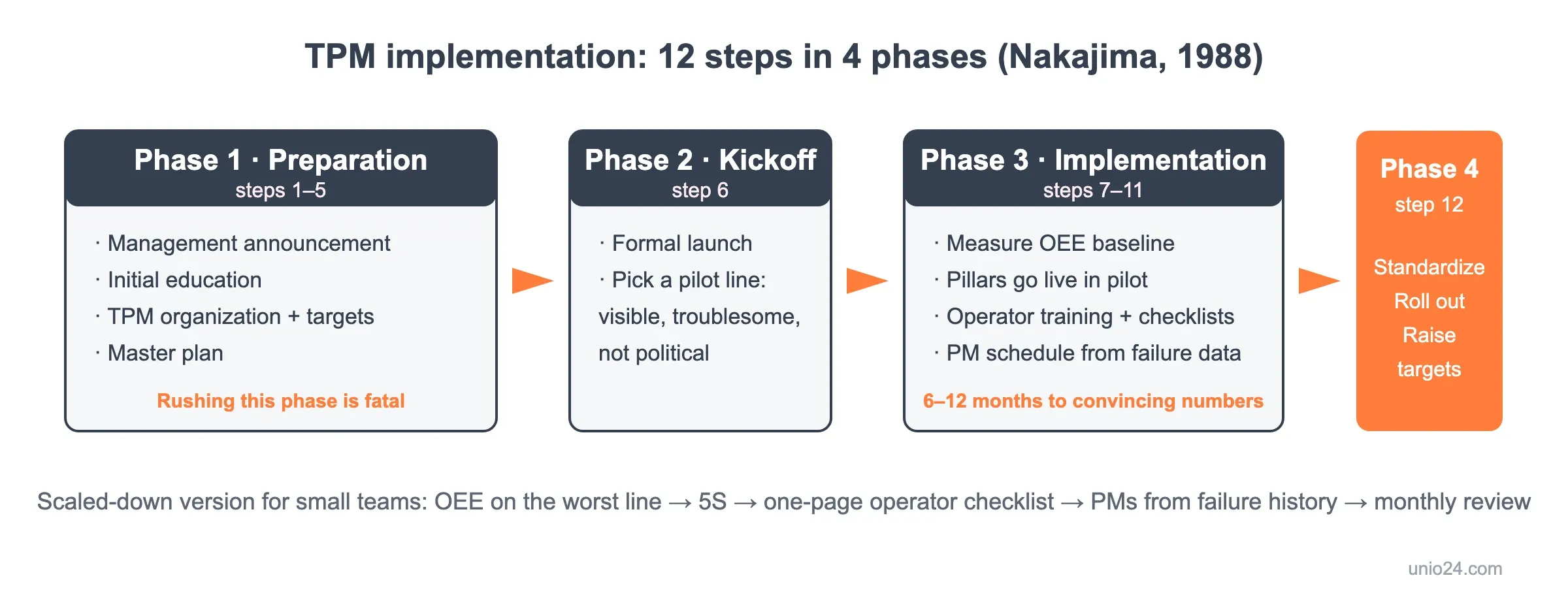
Phase 1: Preparation (steps 1–5). Management announces the program, runs initial education, forms the TPM organization (steering committee plus small pillar teams), sets baseline targets, and writes a master plan. Rushing this phase is fatal: if the plant sees TPM as a slogan the maintenance manager invented, it's over before the kickoff.
Phase 2: Kickoff (step 6). A formal launch, ideally with a pilot area chosen. Pick one line or cell. Visible, troublesome, but not your most political asset.
Phase 3: Implementation (steps 7–11). The pillars go live in the pilot: measure OEE, run focused-improvement events on the biggest of the six losses, start autonomous maintenance with operator training and checklists, build the planned-maintenance schedule from failure data, train continuously, and pull lessons into new-equipment decisions. Expect 6–12 months before the pilot numbers are convincing.
Phase 4: Stabilization (step 12). Standardize what worked, roll out to further areas, raise targets. Mature plants aim at JIPM's TPM Excellence Award criteria (the official outline requires at least two years of activity across all eight pillars before a plant can even apply); most companies just need the discipline of re-baselining OEE every year.
If twelve steps sound heavy, remember they were written for large Japanese plants in the 1980s. The scaled-down version that fits a 50-person operation: measure OEE on your worst line, clean it up 5S-style, give operators a one-page daily checklist, schedule PMs from your real failure history, and look at the numbers every month. That's TPM in spirit, and it captures most of the benefit.
Does TPM Work Outside Big Manufacturing?
The temple diagrams and Japanese terminology make TPM look like an enterprise-only sport. The mechanics say otherwise. A construction fleet, a hospital's biomedical equipment, a food-processing SMB: anywhere equipment failure costs real money, the same three moves apply. The people using equipment report its condition. Servicing follows a plan instead of a breakdown. Someone tracks whether things are improving.
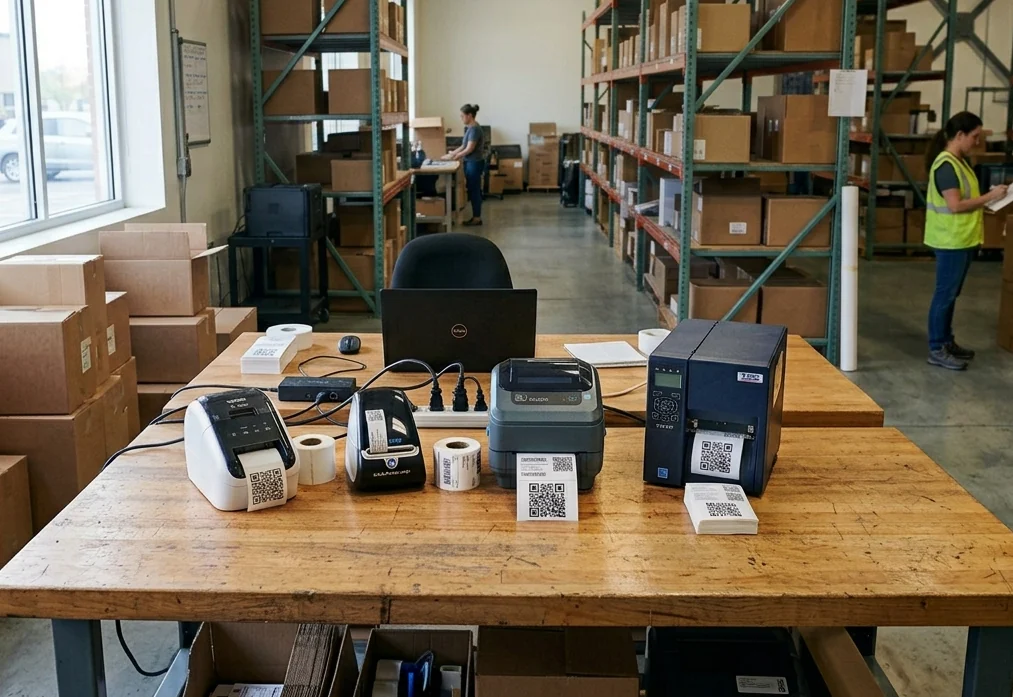
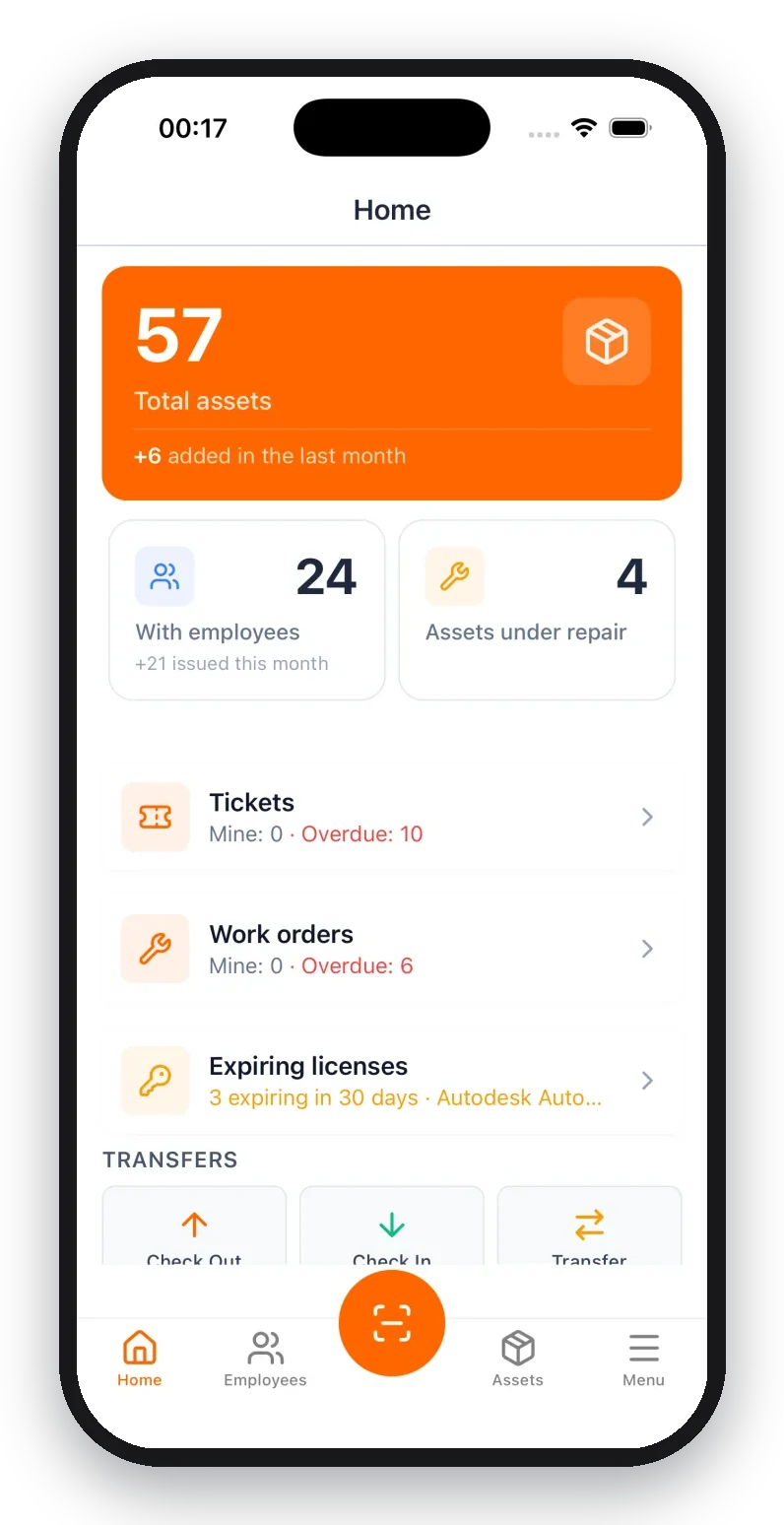
What small teams can't copy is the bureaucracy of committees, pillar audits, and award applications. What they can copy cheaply is the information layer that makes operator ownership work: every asset identified and labeled, service history in one place, and an operator's defect report turning into a work order in seconds from a phone instead of a note taped to the machine. That workflow (scan the tag, describe the problem, a work order lands with a technician) is the autonomous-maintenance loop minus the ceremony. If you're comparing tools for this, the CMMS vs asset management breakdown covers which class of system does what.
A 60-asset machine shop can cut breakdown hours roughly in half within two quarters using nothing more sophisticated than that loop plus a monthly review of which machines generated the most unplanned work. No steering committee involved.
Where TPM Programs Fail
Most dead TPM programs died one of four ways:
Treating it as a maintenance-department project. If production managers keep measuring operators purely on output, operators will keep running machines with strange noises. TPM lives or dies on whether production owns equipment health.
Skipping the baseline. Without a starting OEE there's no proof of progress, and the program gets cut in the first budget squeeze. Measure first, even if the number is embarrassing.
Checklist theater. Laminated sheets get initialed at shift end without anyone looking at the machine. The countermeasure is checklists short enough to actually do, layered spot audits where a manager runs the same check, and visible follow-up on what operators report.
Ignoring reports. The fastest way to end operator participation is to let their first three defect reports sit unanswered. Route reports into a system with an owner and a due date, not into a suggestion box.
Frequently Asked Questions
Is "total preventive maintenance" the same as total productive maintenance?
Effectively yes. "Total preventive maintenance" is an older rendering of the same Japanese methodology — Nippondenso's 1971 program combined preventive maintenance with total employee involvement, and both names circulated in early literature. Modern JIPM materials and lean practice standardized on "total productive maintenance." A course or job posting that says "total preventive maintenance" almost always means TPM, not just a preventive-maintenance schedule.
What is the difference between TPM and TQM?
TQM (Total Quality Management) targets the quality of processes and products; TPM targets the reliability of the equipment those processes run on. They share the same continuous-improvement roots and the "total participation" principle. The overlap is TPM's quality-maintenance pillar, which eliminates equipment conditions that cause defects. Plants often run both — TPM keeps machines predictable, TQM keeps the process capable.
How is TPM different from reliability-centered maintenance (RCM)?
RCM is an engineering analysis method: for each asset you evaluate failure modes and consequences, then choose the right strategy — run-to-failure, preventive, or predictive — per component. TPM is an organizational system that defines who maintains equipment and how improvement happens. They're complementary: RCM analysis can decide what belongs in the planned-maintenance pillar of a TPM program.
Can you run TPM without software?
The philosophy doesn't require software, and a pilot can start with paper checklists. In practice two pillars break without a system of record: planned maintenance needs per-asset failure history to schedule from, and autonomous maintenance needs operator reports to become trackable work orders instead of notes taped to machines. That's a modest asset-management or CMMS requirement, not an ERP project.
What does TPM stand for in maintenance — and is it related to the TPM security chip?
In manufacturing and maintenance, TPM stands for Total Productive Maintenance. The identically named TPM in computing — Trusted Platform Module, the security chip Windows 11 requires — is unrelated. The abbreviation collision is why search results for "TPM meaning" mix factory-floor methodology with PC hardware.
The Bottom Line
TPM makes equipment reliability everyone's job. OEE keeps score, the eight pillars give it structure, and autonomous maintenance by operators is the part that actually changes behavior. The target (zero breakdowns, zero defects, zero accidents) stays out of reach by design; the improvement happens while chasing it.
You don't need the full JIPM apparatus to benefit. You need a baseline, operator eyes on the equipment every day, planned work driven by failure data, and a system that keeps score. The committees are optional.
Put the Infrastructure Under It — Free
The unglamorous prerequisite for all of this is knowing what equipment you have, where it is, and what's been done to it. That's the layer UNIO24 covers: asset registry with QR labels, maintenance schedules and service history, and work orders your operators can raise from a phone at the machine.
It's free for up to 50 assets, with no trial clock. Fifty assets is one line or one workshop: exactly the pilot area a TPM rollout should start with. Baseline it, run the loop for a quarter, and let the breakdown numbers make the case to management for you.
Running a TPM program, or trying to restart a stalled one? Start with UNIO24 for free and put your pilot line in it this week.