The audit that looks at how the part is being made, not the part — and puts a manager on the floor holding the same checklist as the operator
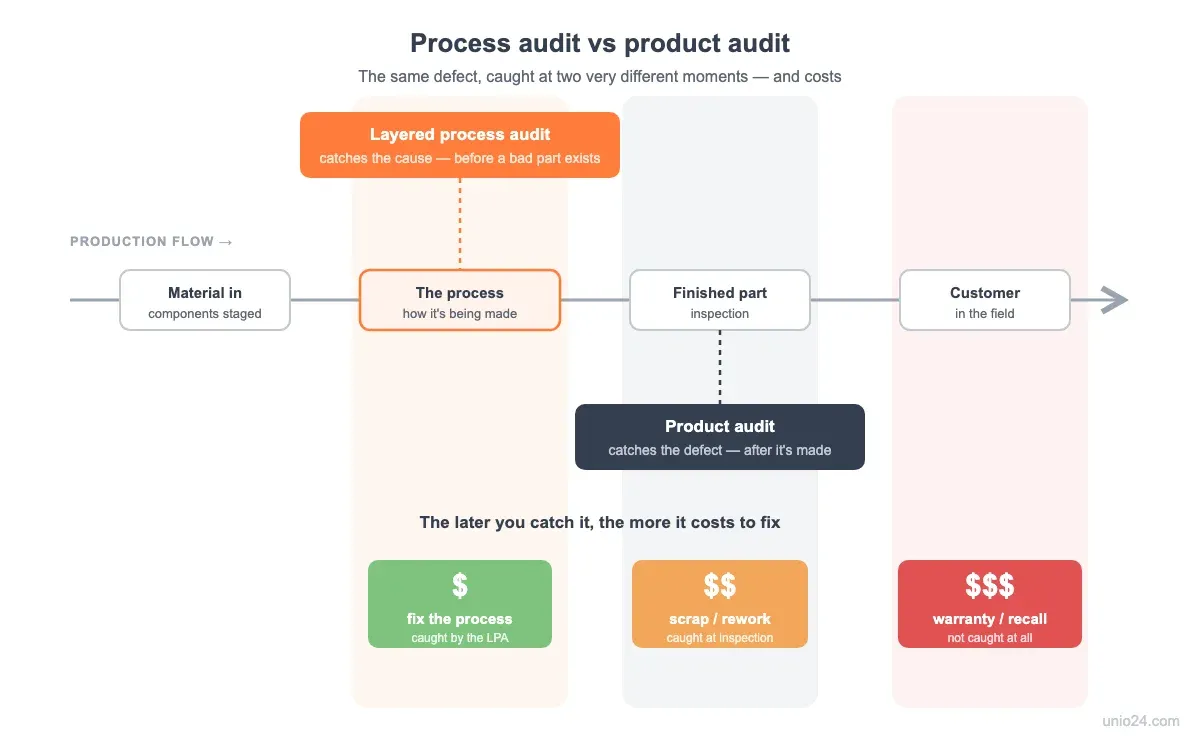
Most quality systems are built to catch a bad part. You inspect the output, compare it to spec, and pull the ones that fail. It works, but it works late: by the time a measurement flags a problem, you've usually made a pile of scrap, and some defects — the ones that only show up as a warranty claim two years later — slip through inspection entirely because the part looked fine leaving the plant.
A layered process audit attacks the problem one step upstream. Instead of asking "is this part good?", it asks "is this job being done the right way?" — and it puts that question in the hands of everyone from the operator to the plant director.
What Is a Layered Process Audit?
A layered process audit (LPA) is a short, standardized audit of how a process is performed — the machine settings, the work sequence, the tooling, the operator's method — rather than an inspection of the finished product. The same audit is carried out by multiple layers of the organization at different frequencies: frontline supervisors often, senior managers rarely.
Two ideas do all the work in that definition.
The first is process, not product. An LPA doesn't measure the bore diameter on the part; it checks whether the operator is using the correct gauge, whether the torque wrench is calibrated, whether the standardized work instruction is being followed. Catch the drifting process and the bad parts never get made.
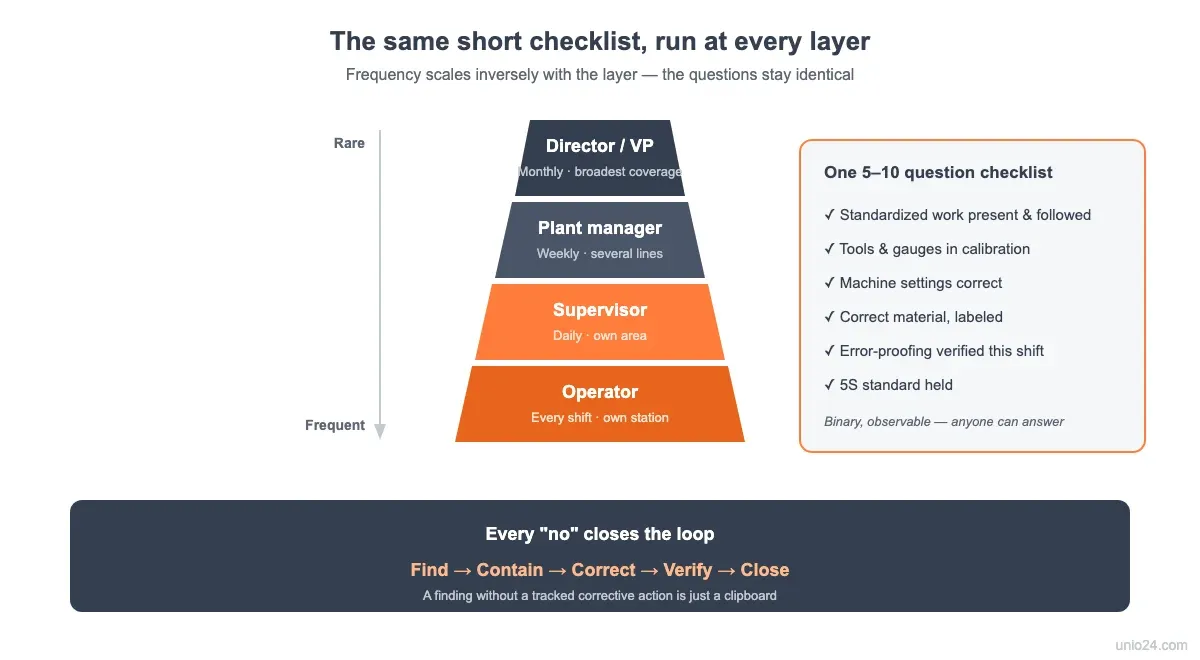
The second is layers. The identical audit is run by people at different levels. A supervisor might run it every shift on their own line. A plant manager runs the same questions weekly across several lines. A director runs them monthly. Nobody needs specialist knowledge, because the questions are written for anyone to answer.
Why the Layers Matter
Running the same audit at multiple levels isn't redundancy for its own sake — it buys three specific things.
The audits check each other. When a supervisor and a manager independently run the same question a week apart, disagreements surface. If the supervisor keeps marking "operator follows the torque sequence — yes" and the plant manager finds it's a no, you've learned something about the supervisor's audit as much as the operator's work.
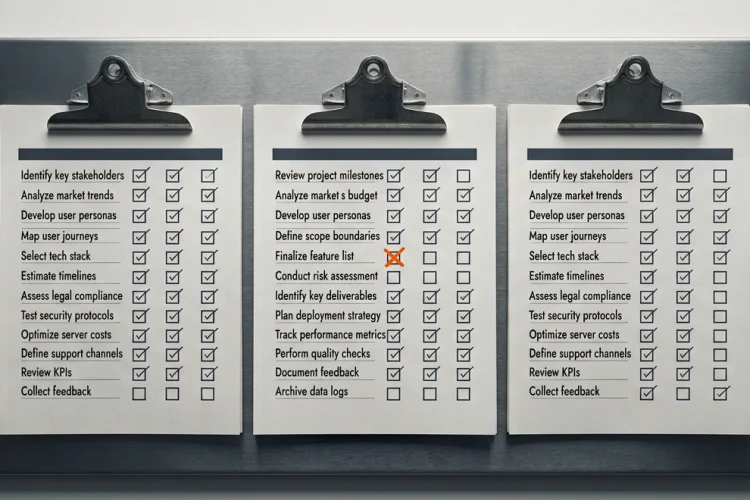
Managers show up on the floor. An LPA program routinely puts senior people at the workstation, holding the same clipboard as the operator. That's a culture signal money can't buy: quality is important enough that the director spends twenty minutes at the line doing the same check as the person running it. Category-leading LPA programs eventually pull 40–50% of headcount into auditing.
Coverage compounds. High-frequency, narrow audits at the bottom layer plus low-frequency, broad audits at the top mean every high-risk process gets seen often, and the whole plant gets seen regularly. No single person carries the load.
Where LPAs Come From: CQI-8 and IATF 16949
Layered process audits started as a General Motors program in the late 1990s and were formalized by the Automotive Industry Action Group as CQI-8, the Layered Process Audit Guideline. CQI-8 is the document most automotive suppliers mean when they say their program "follows CQI-8": it standardizes audit content, layer frequencies, question design, and the corrective-action loop.
The relationship to IATF 16949, the automotive quality-management standard, trips people up. IATF 16949 requires manufacturing process audits but doesn't name the LPA method. In practice, most automotive OEMs require LPAs from their suppliers as a customer-specific requirement, and auditors expect to see a running program with tiered participation and closed findings. So for a Tier 1 or Tier 2 supplier, LPAs are effectively mandatory even though the standard frames them as one acceptable form of process audit.
The automotive origin gives the term its baggage: the diagrams and vocabulary all say factory. But the mechanics have nothing to do with cars, or even with manufacturing.
Process Audit vs Product Audit
The distinction is the whole reason LPAs exist, so it's worth making concrete.
| Product audit | Layered process audit | |
|---|---|---|
| What it checks | The finished part against spec | How the part is being made |
| When it catches problems | After the defect exists | Before the process produces defects |
| Who runs it | Quality department | Every layer, operators to executives |
| Typical question | "Is this dimension in tolerance?" | "Is the operator following the torque sequence?" |
| Blind spot | Latent defects that pass inspection | Needs disciplined follow-up to matter |
Product audits aren't wrong — you need them. But they're reactive by nature, and small sample sizes plus inspection delay mean the scrap is often already made. Process audits move the check upstream, to the conditions that cause defects in the first place.
A Layered Process Audit Checklist
The heart of an LPA is a short list of yes/no questions, written so anyone can answer them without training. Keep it under ten questions so a supervisor can run it in under ten minutes. Below is a starter checklist you can adapt — the categories matter more than the exact wording.
Standardized work
- Is the current standardized work instruction present at the station and the correct revision?
- Is the operator following the documented work sequence?
Tooling and equipment
- Are the required tools and gauges present, and within their calibration date?
- Are machine settings and parameters at the specified values?
Materials and identification
- Is the correct material/component in use, and correctly labeled?
- Are non-conforming or quarantined items segregated from good stock?
Error-proofing and safety
- Are error-proofing (poka-yoke) devices present and verified working this shift?
- Is required PPE worn and are safety guards in place?
5S and control
- Is the workspace to its 5S standard, with a place for everything?
- Are the current quality alerts / reaction plan visible at the station?
The mark of a good LPA question is that it's binary and observable — a stranger to the process could answer it by looking. "Is the operator doing a good job?" is a bad question. "Is the operator tightening the four bolts in the numbered order shown on the work instruction?" is a good one.
Closing the Loop: Findings to Corrective Action
An LPA program that only records red marks is theater. The value is in what happens after a "no."
When an audit item fails, the auditor does two things. First, contain — take immediate action so potentially defective product doesn't move downstream (stop the station, quarantine the last batch, re-run the check). Many corrections are simple enough that the auditor fixes them on the spot. Second, log the finding and assign a corrective action with an owner and a due date, then follow it to completion.
That loop — find, contain, correct, verify, close — is where LPAs actually reduce cost of quality. Robust programs capture every finding so management can see patterns: the same question failing across three lines points at a training gap or an unclear work instruction, not three careless operators.
An LPA Example
Take a station that torques four bolts on a bracket in a specified cross-pattern sequence, because tightening them in the wrong order warps the seat and causes a rattle the customer hears six months later — a defect no dimensional check at the plant would catch.
The LPA question is: "Is the operator tightening the four bolts in the numbered sequence on the work instruction?" A supervisor audits it every shift. The plant manager audits the same question, along with a dozen others, once a week. In week three the plant manager marks it "no" — the operator has been going clockwise, not in the cross-pattern, and the supervisor never caught it because the supervisor didn't know the sequence mattered either.
The finding contains the problem (re-inspect the shift's output), triggers a corrective action (re-train both the operator and the supervisor, add a sequence diagram to the station), and closes when a follow-up audit confirms the change held. One question, run at two layers, caught a latent field failure that product inspection was structurally blind to. That's the whole method in miniature.
The Same Pattern Beyond the Factory
Strip a layered process audit down to its mechanics — a short, observable checklist, run at several layers on different cadences, with every miss turning into a tracked fix — and none of it is specific to a production line. The pattern fits anywhere there's standardized work that quietly drifts and a real cost when it does. The word "process" is doing more work than the word "manufacturing".
- IT and service desks. A "ticket handled to standard" check: categorized correctly, SLA clock started, resolution documented for the knowledge base. The team lead audits a few tickets a day; the IT manager samples weekly. Same structure, no factory in sight.
- Employee onboarding and offboarding. Offboarding is a notorious drift point — the leaver's laptop, badge, and system access all actually revoked. A layered check has a manager spot-verify that the steps happened, not just that a box got ticked.
- Healthcare and labs. Adherence to a clinical or sample-handling procedure, checked by a charge nurse each shift and a quality manager weekly. It's the LPA structure exactly, in different vocabulary.
- Retail and hospitality. Opening and closing routines, food-safety steps, planogram compliance — short checks a shift lead runs daily and a district manager runs on store visits.
- Back-office and finance. The month-end close, customer onboarding, contract review: repeatable processes where a skipped step costs real money, and where a manager running the same checklist catches the drift the doer stopped seeing.
The tell is always identical: a process people are meant to run the same way every time, where "close enough" compounds into rework, risk, or a customer problem. If that describes something you run — on a shop floor or in a spreadsheet — the layered-audit pattern applies. The automotive industry just formalized and named it first.
Running LPAs Without Enterprise Software
The category-leading LPA tools are built for large automotive suppliers, and the classic guides gate their depth behind long ebooks. If you're a smaller manufacturer, a job shop, a service or IT team, or any operation that wants the discipline without the enterprise price tag, strip it back to what a layered audit actually requires:
- A schedule of recurring checks keyed to the auditor's layer — daily for supervisors, weekly and monthly for higher tiers.
- A short mobile checklist anyone can run at the station, ideally by scanning the workstation or asset to pull up the right questions.
- A findings-to-action loop so a failed item becomes a tracked corrective action with an owner and a due date, not a note on a clipboard.
That's an operational cadence, and it maps onto tooling most operations already have or can adopt cheaply. In UNIO24, the audit workflow runs the mobile checklist and records results per station, location, or asset, scheduled checks fire the recurring cadence each layer owes, and a failed item becomes a work order with an owner and due date — the contain-and-correct loop, tracked to closure. Whether the "station" is a CNC cell, a service desk, or a retail location, the mechanics are the same. It isn't dedicated automotive LPA software, and if you're a Tier 1 supplier being audited against CQI-8 you'll likely want a purpose-built tool. For everyone who just wants the method working, it's the infrastructure the method actually runs on.
LPAs are also a natural companion to the maintenance side of the same discipline: both put frontline people in charge of catching drift early, and both live or die on whether findings turn into tracked action instead of ignored notes. If you're building a proactive quality culture, an LPA program and a pre-emptive maintenance program are two halves of the same idea.
Frequently Asked Questions
What is meant by a layered process audit?
A layered process audit (LPA) is a short, standardized check of how a job is actually done — the settings, the sequence, the tools, the operator's method — rather than an inspection of the finished part. The "layered" part means the same audit is run by several levels of the organization on different frequencies: an operator or supervisor daily, a plant manager weekly, a director monthly. The overlap makes the audit self-checking and signals that quality is everyone's job, not just the quality department's.
What is the CQI-8 layered process audit guideline?
CQI-8 is the Layered Process Audit Guideline published by the Automotive Industry Action Group (AIAG). It's the reference that standardizes how LPAs are designed and run across the automotive supply chain: audit content, layer frequencies, question design, and the corrective-action loop. It grew out of a General Motors program from the late 1990s, and it's the document most suppliers mean when they say their program "follows CQI-8."
Is a layered process audit required by IATF 16949?
IATF 16949 requires manufacturing process audits but doesn't mandate the LPA method by name. In practice most automotive OEMs require layered process audits from suppliers as a customer-specific requirement, and auditors expect a program with tiered participation and closed-out findings. So for a Tier 1 or Tier 2 supplier, LPAs are effectively required even though the standard itself lists them as one acceptable form of process audit.
What is the difference between a process audit and a product audit?
A product audit inspects the output — you measure the finished part against spec. A process audit checks the way the part is being made while it's being made: is the operator following standardized work, are the machine settings right, is the correct gauge in use. Product audits catch defects after they exist; process audits catch the conditions that create defects before the bad parts pile up. LPAs are process audits run at multiple organizational layers.
How often should layered process audits be done?
Frequency scales inversely with the auditor's layer. Frontline supervisors typically audit their own area daily or several times a week; middle managers weekly; senior managers and directors monthly or quarterly. The same short checklist is used at every layer — only the cadence and breadth of coverage change. A common start: a 5–10 question audit under ten minutes, run once per shift per line by the supervisor, with higher layers sampling on top.
Do layered process audits only apply to manufacturing?
No. The method was formalized in automotive manufacturing (CQI-8), but the mechanics apply to any standardized process that can drift. IT service desks audit whether tickets are handled to standard, HR teams audit that offboarding steps actually happened, healthcare audits clinical-procedure adherence, and finance audits the month-end close. Anywhere there's a process people are supposed to run the same way every time — and a real cost when they don't — a short checklist run at multiple layers with tracked follow-up works the same way it does on a factory floor.
The Bottom Line
A layered process audit is a simple idea carried out with discipline: check how the work is done, not just what comes out; write the questions so anyone can answer them; and run the same audit at every level of the company so it checks itself and puts managers on the floor. The method comes from automotive quality and CQI-8, but the mechanics help anywhere a standardized process can drift out of spec while everyone assumes it's fine.
The program only works if two things hold: the questions stay short and observable, and every failed item turns into a tracked correction that actually gets closed. Miss the second and you have a stack of clipboards. Get both right and you catch the drift before it becomes scrap, or worse, a warranty claim.
Put the Cadence and the Loop in One Place — Free
The unglamorous requirement behind any LPA program is a recurring schedule, a checklist people run at the station, and a findings-to-action loop that closes. That's the layer UNIO24 covers: mobile audit checklists run per station or asset, scheduled recurring checks for each layer's cadence, and failed items that become work orders with an owner and a due date.
It's free for up to 50 assets, with no trial clock — enough to stand up the audit cadence on one line or cell, run it for a quarter, and let the closed-out findings make the case for rolling it wider.
Standing up an LPA program, or trying to make a stalled one stick? Start with UNIO24 for free and put your first line's audit cadence in it this week.