Every failure opens a warning window first. Pre-emptive maintenance is the discipline of acting inside it, not after it closes.
An office air conditioner rarely dies without warning. It cools a little weaker each week, runs longer cycles, starts dripping — and somewhere in that sequence there's a Tuesday afternoon where a $150 service visit and thirty planned minutes fix it. Skip that Tuesday, and the unit quits in the middle of a July heatwave, precisely when it's running at full load — and the bill now includes an emergency call-out at peak-season rates, an overheating server room, and an office full of people who can't think past the temperature.
Pre-emptive maintenance is the whole family of strategies built to catch the Tuesday version. The term itself is muddier than it looks — vendors define it in contradictory ways — so it's worth pinning down what it covers, what it saves, and how to start without a reliability engineer on staff.
What Is Pre-emptive Maintenance?
Pre-emptive maintenance (also written preemptive maintenance) is any maintenance performed before equipment fails rather than in response to a breakdown. It's an umbrella term for the proactive strategies — preventive, condition-based, and predictive maintenance — and the direct opposite of reactive ("run to failure, then fix it") maintenance.
The word you'll meet in reliability literature for the same idea is proactive maintenance. "Pre-emptive" is the everyday rendering; standards and textbooks mostly say proactive, preventive, or predictive. If you're searching for software or training, those are the terms that bring up the useful results.
One Term, Several Definitions: Sorting the Confusion
The term has no standardized definition, and search results quietly contradict each other. Some sources use pre-emptive maintenance as another name for preventive maintenance; others treat it as a synonym for predictive maintenance. Both readings are half right: each names one branch and calls it the tree.
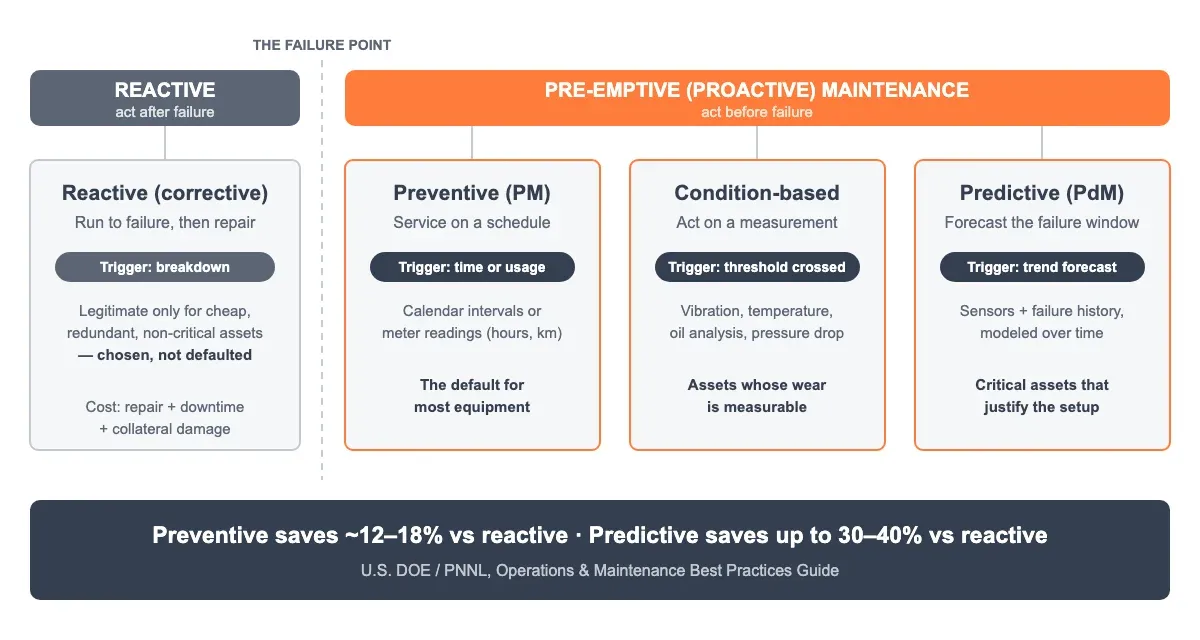
The clean mental model is a spectrum of triggers:
| Strategy | Trigger | What it needs | Where it fits |
|---|---|---|---|
| Reactive (corrective) | Failure already happened | A repair budget and nerves | Cheap, non-critical, redundant assets — by choice |
| Preventive (PM) | Calendar or usage interval | A schedule and task checklists | The default for most equipment |
| Condition-based (CBM) | A monitored value crosses a threshold | Inspections or simple sensors | Assets whose wear is measurable (filters, belts, fluids) |
| Predictive (PdM) | A forecast built from trend data | Instrumentation + failure history | Critical, expensive assets that justify the setup |
Everything below the first row is pre-emptive maintenance. The rows differ only in how early — and how precisely — they act before the failure point.
The Types, In Practice
Time-based preventive maintenance is the workhorse: inspect the compressor quarterly, service the forklift every six months. Intervals come from the manufacturer's manual at first, then from your own failure history once you have one. Its known weakness is servicing things that didn't need it yet — the price of simplicity.
Usage-based preventive maintenance swaps the calendar for meter readings: every 250 engine hours, every 10,000 cycles, every 5,000 km. Fairer to equipment that works irregularly — a generator that ran twice this winter doesn't need the same attention as one running nightly.
Condition-based maintenance replaces "it's been 90 days" with "the measurement says so": act when vibration passes a threshold, oil analysis shows metal, or the filter's pressure drop doubles. Many CBM checks need nothing smarter than a technician with a checklist and a thermometer.
Predictive maintenance takes CBM one step further — instead of reacting to a crossed threshold, it models the trend and forecasts the failure window. This is the branch that involves vibration spectra, IoT sensors, and increasingly machine learning. It's also the branch with real entry costs, which is why it belongs on your most critical assets, not on the office door closer.
If you want the organizational system that wraps these strategies in operator ownership and continuous improvement, that's Total Productive Maintenance — a related but bigger commitment. On the quality side, the same proactive discipline shows up as layered process audits: short checks of how work is done, run at every level of the company.
What Pre-emptive Maintenance Actually Saves
The most-cited numbers come from the U.S. Department of Energy's Operations & Maintenance Best Practices Guide (PNNL, Release 3.0): a functioning preventive program saves an estimated 12–18% over reactive maintenance, and a predictive program 8–12% over preventive — up to 30–40% over pure reactive. The guide is from 2010; the instrumentation got cheaper since, the ratios have held up.
The per-repair arithmetic is easier to feel than percentages. A planned repair is the part plus scheduled labor. An unplanned failure is the part, plus overtime, plus expedited shipping, plus whatever the machine damaged on its way down, plus every hour of downtime — and downtime, not the repair, is usually the biggest line. That's also why the savings case is strongest for equipment whose stoppage blocks other work: the line, the excavator on a deadline job, the server room cooling.
One caveat: pre-emptive maintenance costs money up front — labor hours, parts replaced early, and the discipline of a schedule. On a genuinely non-critical asset, a PM program can cost more than it saves. Which is why the first implementation step below is deciding which assets deserve it, not writing schedules for everything.
How to Start: Six Steps
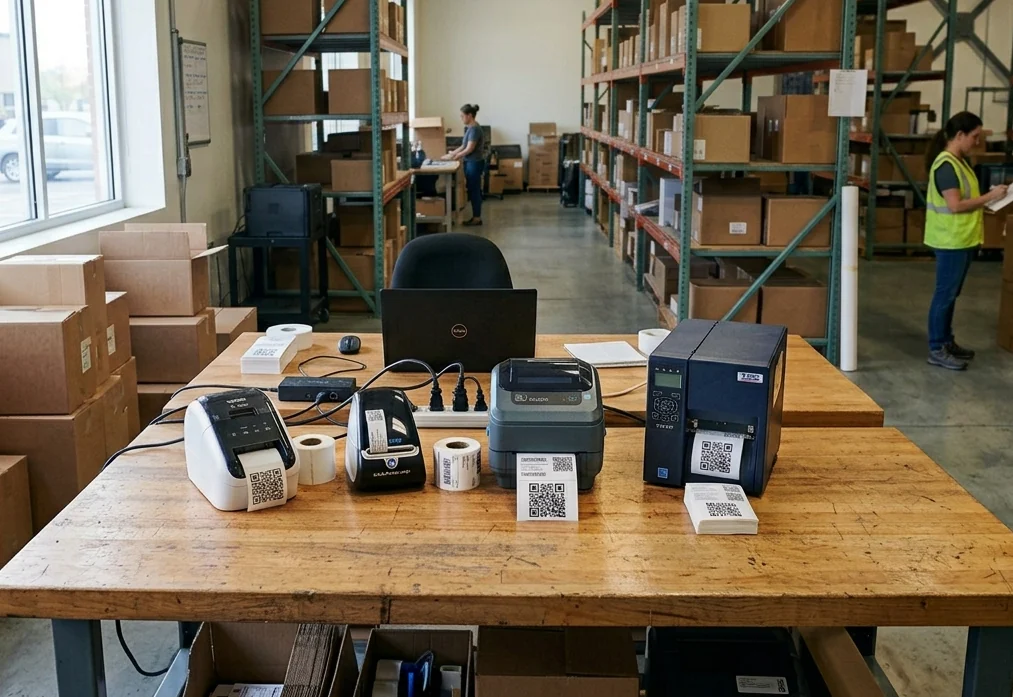
1. Build the asset registry. You can't schedule maintenance for equipment you can't identify. Every asset gets an ID and a tag or QR label, so history and tasks attach to this compressor, not "the compressor".
2. Rank assets by failure cost. Not by purchase price — by what an unexpected failure costs in downtime, safety, and collateral damage. A $300 pump that stops production outranks a $30,000 machine with a warm standby next to it.
3. Assign a strategy per class. Top of the ranking gets condition monitoring or predictive treatment; the broad middle gets time- or usage-based PM; the bottom gets deliberate run-to-failure with a spare on the shelf. Writing "run to failure" next to an asset's name is a decision; having no plan is not.
4. Set intervals from the manual, then correct with history. Manufacturer recommendations are the starting point, and they're conservative by design. After a year of your own data — what failed, when, in what conditions — intervals earn adjustment in both directions.
5. Route everything through work orders. A schedule that lives in someone's head retires with them. Each due task should fire a work order with a checklist, an owner, and a completion record. This is where a maintenance management system stops being optional: per-asset service history is the raw material for every improvement in step 6. (Unsure whether you need a CMMS or an asset management platform for this? Here's the difference.)
6. Review the two numbers that matter. MTBF tells you whether failures are getting rarer; MTTR tells you whether repairs are getting faster. If MTBF isn't growing on the assets you're maintaining pre-emptively, the intervals or the tasks are wrong — that's a finding, not a failure of the approach.
Beyond the Factory Floor
The literature talks about production lines, but the failure-warning window exists everywhere equipment does:
- Offices and facilities — HVAC filters, elevator service, and the UPS batteries whose entire job is to work during the one outage nobody scheduled. A dead UPS discovered during the blackout is reactive maintenance at its purest.
- IT fleets — laptop batteries below 80% health, drives throwing SMART warnings, machines aging past their refresh window. IT calls it lifecycle management; the logic is identical.
- Construction and field equipment — engine-hour-based servicing for fleet and heavy tools, where a failure doesn't just idle the machine, it idles the crew standing around it.
The pattern repeats: the further a failure's cost reaches beyond the broken part itself, the more pre-emptive attention the asset deserves.
Frequently Asked Questions
Is pre-emptive maintenance the same as predictive maintenance?
No — predictive maintenance is one form of pre-emptive maintenance, not a synonym. Some vendors use the terms interchangeably because both act before failure, but pre-emptive (or proactive) maintenance is the umbrella covering every before-failure strategy: scheduled preventive work, condition-based checks, and predictive maintenance driven by trend data. A paper calendar of quarterly inspections is pre-emptive with zero sensors involved.
What is the difference between preventive (PM) and predictive (PdM) maintenance?
The trigger. Preventive maintenance runs on a fixed schedule — every 90 days or every 500 operating hours — whether the machine needs it or not. Predictive maintenance watches condition data (vibration, temperature, oil analysis) and forecasts when a failure is developing, so work happens only when evidence says it should. PM is cheaper to set up; PdM wastes fewer parts and hours but needs monitoring instrumentation and enough failure history to model.
What are the four types of maintenance?
The common four-way split: reactive (corrective) maintenance after a failure, preventive maintenance on a time or usage schedule, condition-based maintenance triggered when a monitored parameter crosses a threshold, and predictive maintenance that forecasts failures from trend data. The last three all act before failure — which is exactly what groups them under the pre-emptive umbrella.
When is it acceptable to just run equipment to failure?
When the failure is cheap, safe, and tolerable: a corridor light bulb, a redundant pump with a spare on the shelf, a $40 fan that costs more to inspect annually than to replace. Run-to-failure is a legitimate strategy when it's chosen deliberately per asset, not when it's the default because nobody planned anything. The test: does an unexpected failure create downtime, safety risk, or collateral damage? If yes, the asset needs a pre-emptive strategy.
Does pre-emptive maintenance apply to IT equipment and software?
Yes, and IT teams already practice it under different names. Replacing laptop batteries at 80% health, swapping drives on SMART warnings, patching before the exploit, and refreshing hardware on a lifecycle schedule are all pre-emptive maintenance — the same act-inside-the-warning-window logic. The term also shows up in IT service management for maintenance windows scheduled before users report degradation.
The Bottom Line
Pre-emptive maintenance is a decision more than a technique: failures become appointments instead of surprises. Preventive schedules, condition checks, and predictive models are just three depths of the same idea, and the right mix is set per asset by what a failure actually costs you. Start with the assets whose downtime hurts, put their tasks on a schedule with real work orders behind it, and let MTBF tell you whether it's working.
Put a System Under the Schedule — Free
The infrastructure for all six steps is an asset registry with service history and scheduled work orders. UNIO24 covers that layer: assets with QR labels, maintenance schedules and per-asset history, and work orders technicians open from a phone at the machine.
It's free for up to 50 assets — enough to put your most failure-expensive equipment on a pre-emptive schedule this week and let a quarter of MTBF data make the case for the rest.
Moving a team off run-to-failure? Start with UNIO24 for free and put your ten most critical assets on a schedule today.