Free Fire Extinguisher Inspection Checklist for Excel
A monthly walk-round checklist you can print, a log for the results, and a register that works out when each extinguisher is due for its annual service, six-year maintenance, and hydrostatic test. Five tabs, works in Microsoft Excel and Google Sheets.
What a fire extinguisher inspection checklist has to cover
Most checklists you'll find are one page long, and they only cover the monthly look. That's the easy part. NFPA 10 asks for a quick visual inspection roughly every 30 days, which anyone on staff can do in under a minute per unit. The hard part is the schedule sitting behind it: a maintenance visit by a qualified technician every 12 months, an internal examination every six years for stored-pressure units on a 12-year test cycle, and a hydrostatic pressure test every 5 or 12 years depending on what's inside the cylinder. A paper sheet taped to the wall can't tell you that the CO2 unit in the server room is due for its hydro test next month.
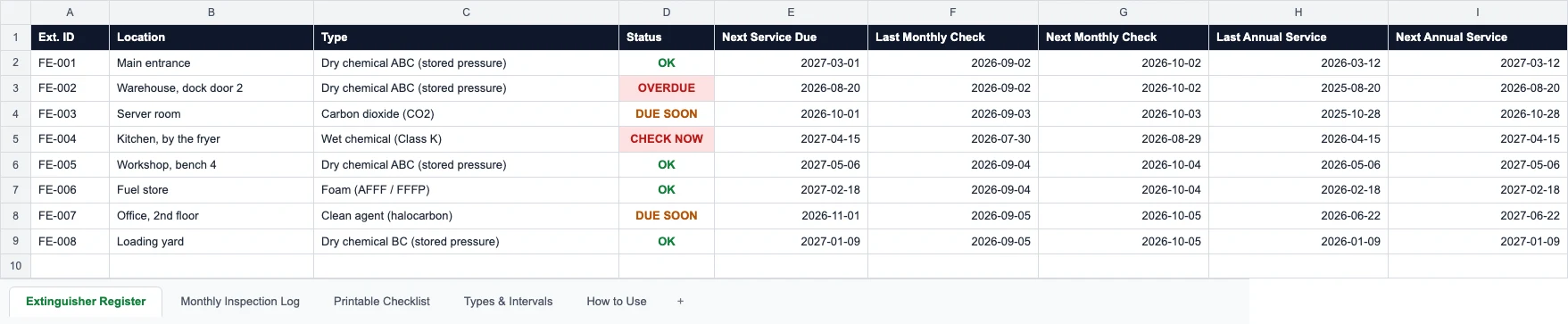
So we built the workbook the other way round. The Extinguisher Register comes first: one row per unit with its type, location, and the dates off the service tag, and it calculates every next due date. Status turns red when a service or test is late (OVERDUE), and when a unit has gone more than 30 days without a monthly check (CHECK NOW). It turns amber when a service falls inside the next 60 days. The Printable Checklist is the clipboard sheet for the walk-round, with your first 20 units already filled in from the register. The Monthly Inspection Log keeps the results, and any single "N" marks the row as a FAIL that stays red until someone enters the date it was fixed.
OSHA 1910.157 expects the same two layers from US employers: a monthly visual inspection, plus an annual maintenance check with a record kept for a year after the last entry (or for the life of the shell, if that's shorter). The register and the log are that record. They don't replace the technician's tag on the unit.
If you look after more than extinguishers, the same idea works for every piece of equipment with a service interval. The maintenance log template covers pumps, HVAC, and vehicles, and the equipment inventory template lists everything you own in the first place.
The monthly check, item by item
These are the eight checks on the printable sheet. They follow the monthly inspection list in NFPA 10, reworded for someone holding a clipboard rather than a code book:
- The extinguisher is in its designated place, not borrowed for the workshop and left on a bench.
- It is visible, and nothing blocks the way to it. Pallets are the usual culprit in warehouses.
- The operating instructions on the nameplate are legible and face outward.
- The pull pin is in and the tamper seal is unbroken.
- The pressure gauge needle is in the green, or for units without a gauge (CO2, mostly), it is full by weight or by hefting.
- No dents, corrosion, leaks, or a nozzle blocked by dirt or insects.
- The hose and nozzle are intact, with no cracks at the fittings.
- The service tag is there and the last annual service date on it is less than 12 months old.
Any failed check goes on the log with what you found. If the unit can't be trusted in a fire (low pressure, a broken seal, damage to the cylinder), take it off the wall, put a spare in its place, and book the technician; don't try to recharge or re-seal it yourself. Initial and date the tag on the extinguisher as well as the sheet, because a fire inspector looks at the tag first.
Annual service, six-year maintenance, and hydro test intervals
The register reads these from the Types & Intervals tab. The values follow NFPA 10:
| Extinguisher type | Hydrostatic test | Six-year maintenance |
|---|---|---|
| Dry chemical, stored pressure (ABC or BC) | every 12 years | yes |
| Dry chemical, cartridge-operated | every 12 years | no (internal check at the annual service) |
| Carbon dioxide (CO2) | every 5 years | no |
| Water, foam (AFFF / FFFP), wet chemical (Class K) | every 5 years | no |
| Clean agent (halocarbon) | every 12 years | yes |
| Dry powder (Class D), stored pressure | every 12 years | yes |
Both clocks start from the manufacture date stamped on the cylinder until the first test or six-year service is done. If you leave those two columns empty on the register, it counts from the manufacture date for you. Those are the columns people forget to fill in, which is how a site ends up with dry chemical units well past their six-year service that nobody has ever opened.
Outside the US the numbers differ. The UK works to BS 5306-3 (annual service plus an extended service every five years for most types) and Australia to AS 1851 (six-monthly inspection). Change the values on the tab and the whole register recalculates. Your fire authority or insurer can set stricter intervals than the standard, and when they do, theirs win.
Who uses a fire extinguisher inspection checklist
Anyone who is the named person for the monthly walk-round, whether or not it's in their job title.
Facilities & building managers
Dozens of units across floors and plant rooms, one register that shows which are late.
Warehouses & distribution
Units by dock doors and racking get blocked and knocked. The monthly check catches both.
Restaurants & commercial kitchens
Class K units by the fryers, on a five-year hydro cycle and their own monthly check.
Schools & offices
A caretaker or office manager doing the walk-round, with a record ready for the fire inspector.
Construction sites
Units that move from site to site, with their location and service dates in one list.
Fleet & vehicles
Extinguishers in vans and trucks, checked with the vehicle and listed by registration.
Spreadsheet or UNIO24 — what fits your site?
The workbook is enough for one building. Several sites and several inspectors is where it starts to slip.
| Capability | Free Template | UNIO24 FreeRecommended for multi-site teams |
|---|---|---|
| The monthly walk-round | ||
| Monthly inspection checklistThe template prints a checklist to fill in by hand and copy into the log. UNIO24 runs the same checklist on a phone. | Partial | Yes |
| Proof the unit was actually visitedA tick on paper can be filled in at a desk. A QR scan records the unit, the time, and who scanned it. | No | Yes |
| Photo of a faultA blocked unit or a broken seal, attached to the inspection record. | No | Yes |
| Service and test dates | ||
| Annual, six-year, and hydro due datesBoth calculate them. The template recalculates when you open it; UNIO24 also sends a reminder. | Partial | Yes |
| Work order for a failed checkThe template marks a FAIL row red. UNIO24 raises a repair ticket and assigns it. | Partial | Yes |
| Data & reliability | ||
| Several sites, several inspectorsOne shared file gets overwritten. UNIO24 handles simultaneous users by site. | Partial | Yes |
| Full history per unitEvery inspection and service for each extinguisher, kept and never overwritten | Partial | Yes |
| Full support | 0/ 7 | 7/ 7 |
Frequently Asked Questions
About the monthly check, the service intervals, and the template itself
Is the fire extinguisher inspection checklist free?
Yes. No cost, no subscription, no card. Enter your name and email and the Excel file downloads straight away.
Who is allowed to do the monthly inspection?
Anyone the employer appoints and shows what to look for. It is a visual check and needs no certification. The annual maintenance, the six-year service, and the hydrostatic test are different: those need a certified technician, and in many US states a licensed fire protection company.
Can I use it as a printable fire extinguisher inspection checklist PDF?
Yes. Open the Printable Checklist tab and print it, or save it as a PDF from Excel. It fits one landscape page and picks up the first 20 extinguishers from your register, so you print once a month without retyping locations.
How often do fire extinguishers need to be inspected?
Visually, about every 30 days, under NFPA 10 and OSHA 1910.157. A qualified technician services each unit every 12 months. On top of that come the six-year internal maintenance for stored-pressure dry chemical and clean agent units, and a hydrostatic test every 5 or 12 years depending on the type.
How long do I have to keep inspection records?
OSHA 1910.157 asks US employers to keep the annual maintenance record for one year after the last entry, or for the life of the shell if that is shorter. Many sites keep everything for longer because insurers and fire inspectors ask for it. The monthly inspection is usually recorded on the tag itself, and the log in this template gives you a second copy you can search.
Does it work outside the US?
Yes, but check the intervals first. The Types & Intervals tab uses NFPA 10 values. For BS 5306-3 in the UK or AS 1851 in Australia, change the hydro and six-year columns there, and the register recalculates every due date.
More templates for equipment that needs checking
The same register idea, applied to the rest of what you look after.
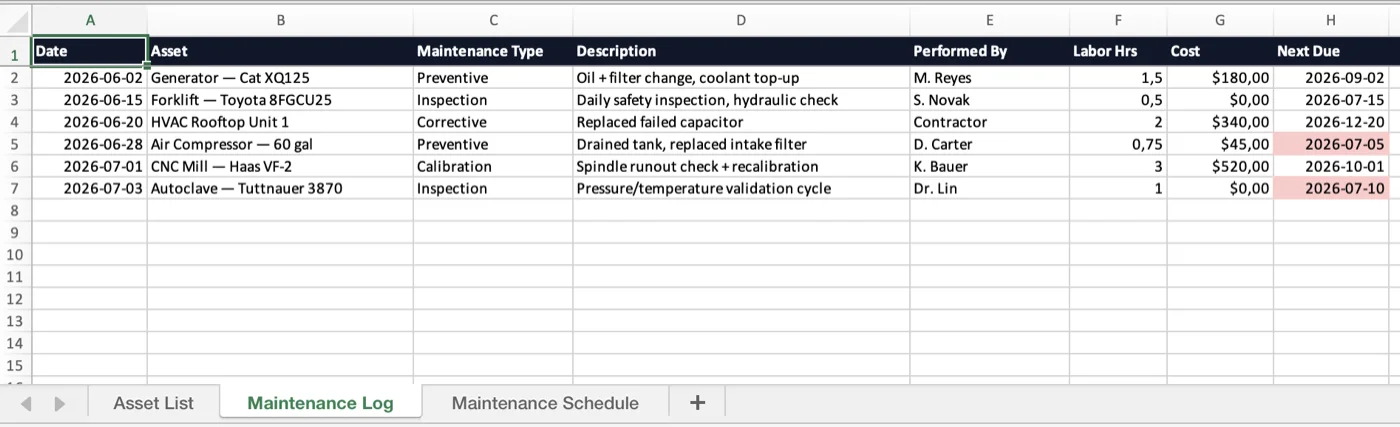
Maintenance Log Template
Service history and a preventive-maintenance schedule for any equipment, with overdue flags.
Read more: Maintenance Log Template
Preventive vs Predictive vs Pre-emptive Maintenance
Which maintenance strategy fits which asset, and how the terms actually differ.
Read more: Preventive vs Predictive vs Pre-emptive Maintenance
Asset Tagging Best Practices: A Practitioner's Guide
Label types and placement, so a scan on the walk-round finds the right unit.
Read more: Asset Tagging Best Practices: A Practitioner's Guide