Free Aerial Lift Inspection Checklist for Scissor and Boom Lifts
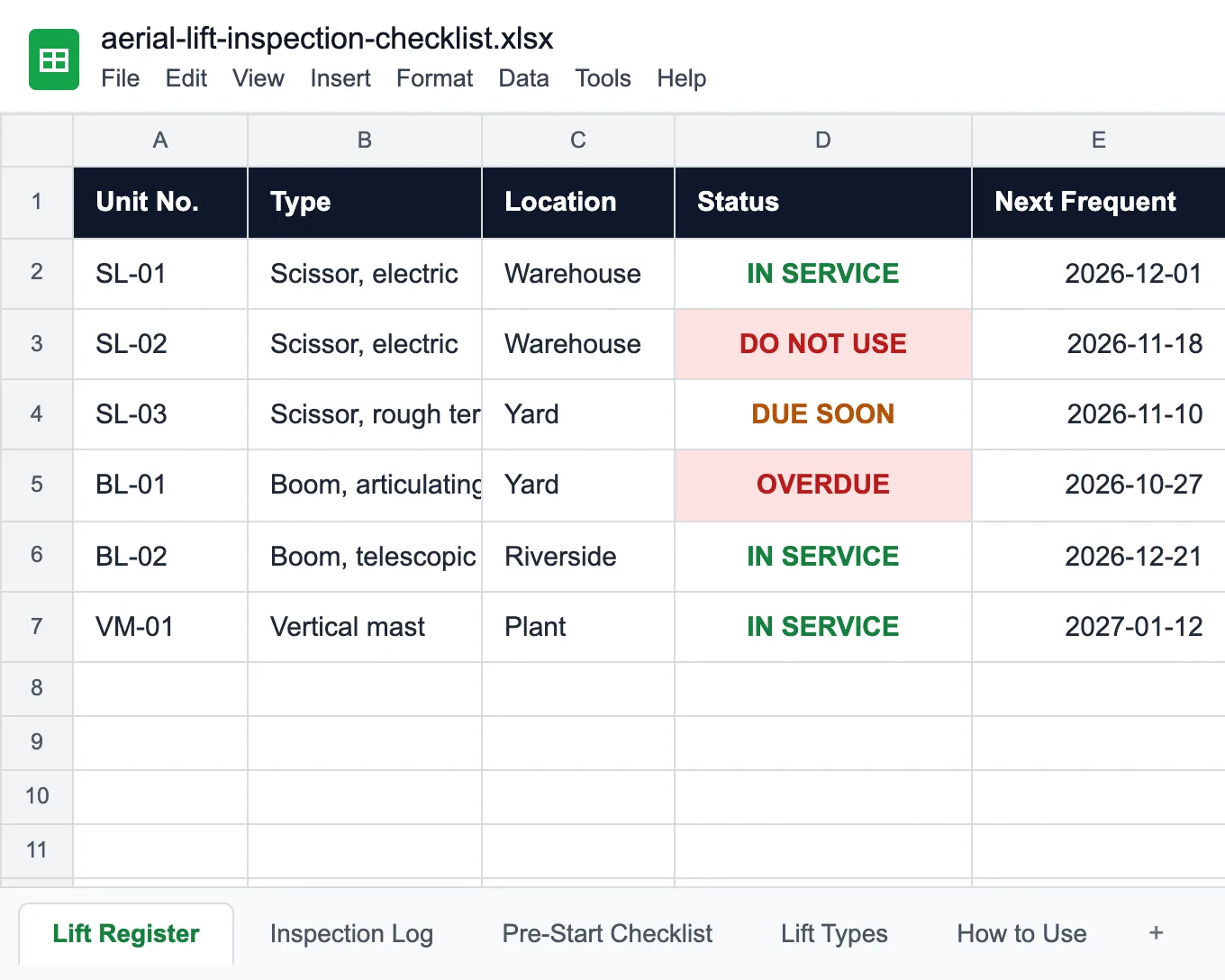
A weekly pre-start checklist the operator fills in before each shift, plus the log and register behind it: a lift with a reported defect stays DO NOT USE until it is repaired, and frequent and annual inspections show OVERDUE or DUE SOON. Works in Microsoft Excel and Google Sheets.
What an aerial lift inspection covers
Scissor lifts, boom lifts and mast lifts (mobile elevating work platforms, or MEWPs) get three layers of inspection under the industry standard. The operator does a pre-start check before each shift. A qualified mechanic does a frequent inspection every three months or 150 hours, whichever comes first, and an annual inspection. Rental lifts arrive with the frequent and annual dates on a decal; the pre-start check is still yours.
The Pre-Start Checklist prints one sheet per lift per week, a column per day:
- Walk-around (power off): tires and wheel nuts, hydraulic leaks and hoses, structure and welds, pothole guards or outriggers, guardrails, entry gate and toe boards, decals and the capacity plate.
- Fluids and power: battery and charger on electric lifts, engine fluids on rough-terrain units, hydraulic oil.
- Function test: ground controls and emergency lowering, platform controls and the enable switch, emergency stops, tilt and motion alarms, brakes and steering, anchor points on booms.
- Work area: overhead power lines, holes, drop-offs and soft ground.
A ticked sheet shows someone looked. It cannot stop the next operator from taking the lift with the broken gate up to the ceiling. So the workbook keeps the record behind it:
Inspection Log. One row per defect, frequent inspection, annual inspection or repair, with PASS or FAIL. A FAIL stays an OPEN DEFECT until the repair date is entered.
Lift Register. One row per lift, owned or rented, with type, location, make and model, serial and platform height. It reads the log, shows DO NOT USE while a defect is open, and runs two clocks: the frequent inspection every 3 months and the annual every 12, where an annual also counts as a frequent. Status reads OVERDUE when either runs out, DUE SOON two weeks before the frequent or a month before the annual, and IN SERVICE otherwise.
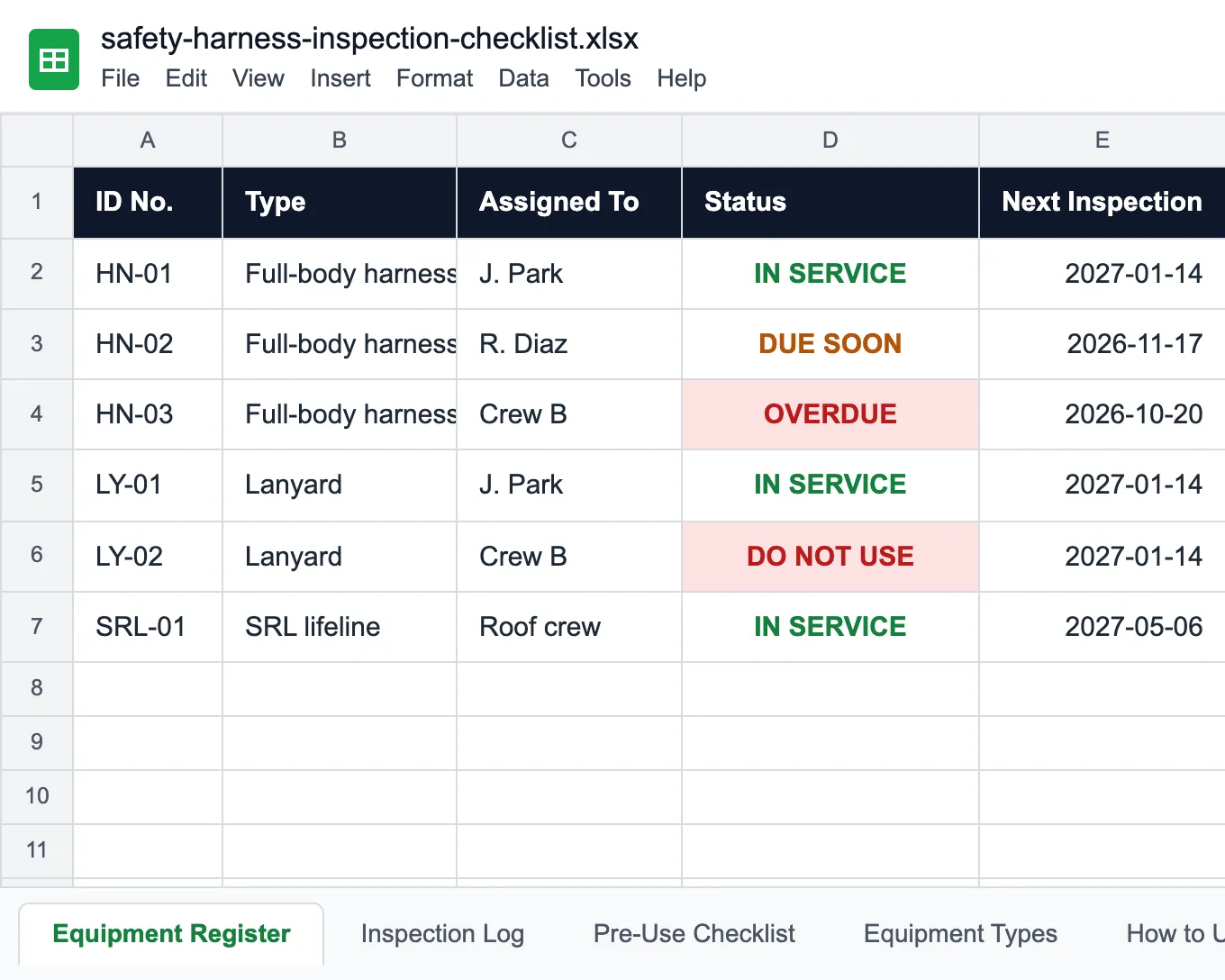
The harness and lanyard worn in a boom lift basket get their own checks: use the safety harness inspection checklist. For ladders, the ladder inspection checklist.
Who uses an aerial lift inspection checklist
Operators check the lift every shift. The equipment manager needs the rest.
General and electrical contractors
Scissor lifts and booms on fit-outs, ceilings and facades.
Warehouses and distribution
Electric scissors for racking, lighting and sprinkler work.
Facilities maintenance
Mast lifts and scissors for lamps, HVAC and atriums.
Manufacturing plants
Lifts for overhead cranes, conveyors and building services.
Rental yards
Inspections between rentals, and the frequent and annual dates on every unit.
Safety managers
Which lifts are tagged out and whose inspection is due, across every site.
Before you fill it in
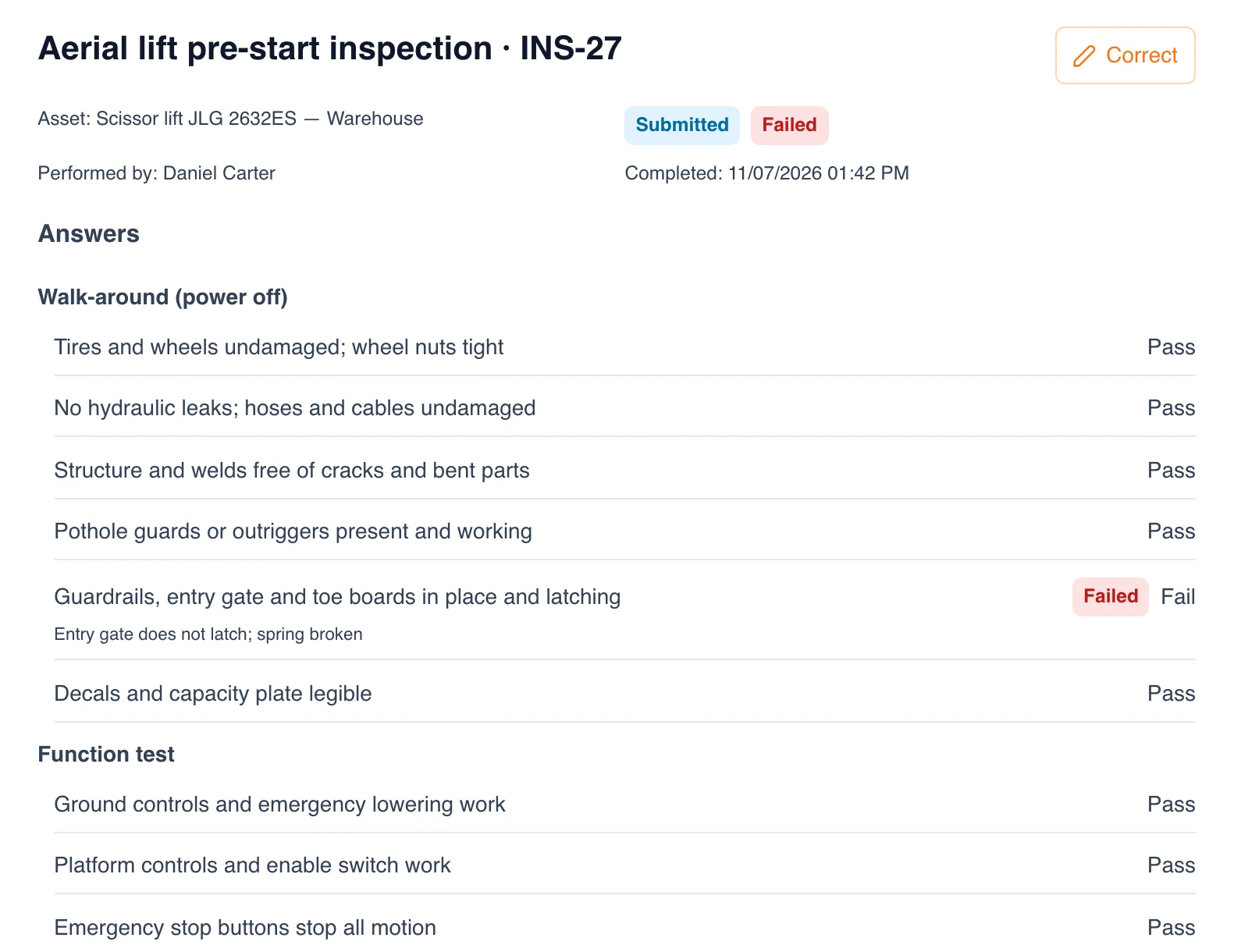
The scissor lift gate was reported broken on Tuesday. Someone took it up on Wednesday.
Try UNIO24 to automate aerial lift inspections.
Try UNIO24 FreeA spreadsheet goes out of date within days, and keeping it current takes someone's time every day. UNIO24 automates that work: each check, defect and repair updates the lift's record as it happens.
| Capability | Free Template | UNIO24 FreeRecommended for lift fleets |
|---|---|---|
| Inspections | ||
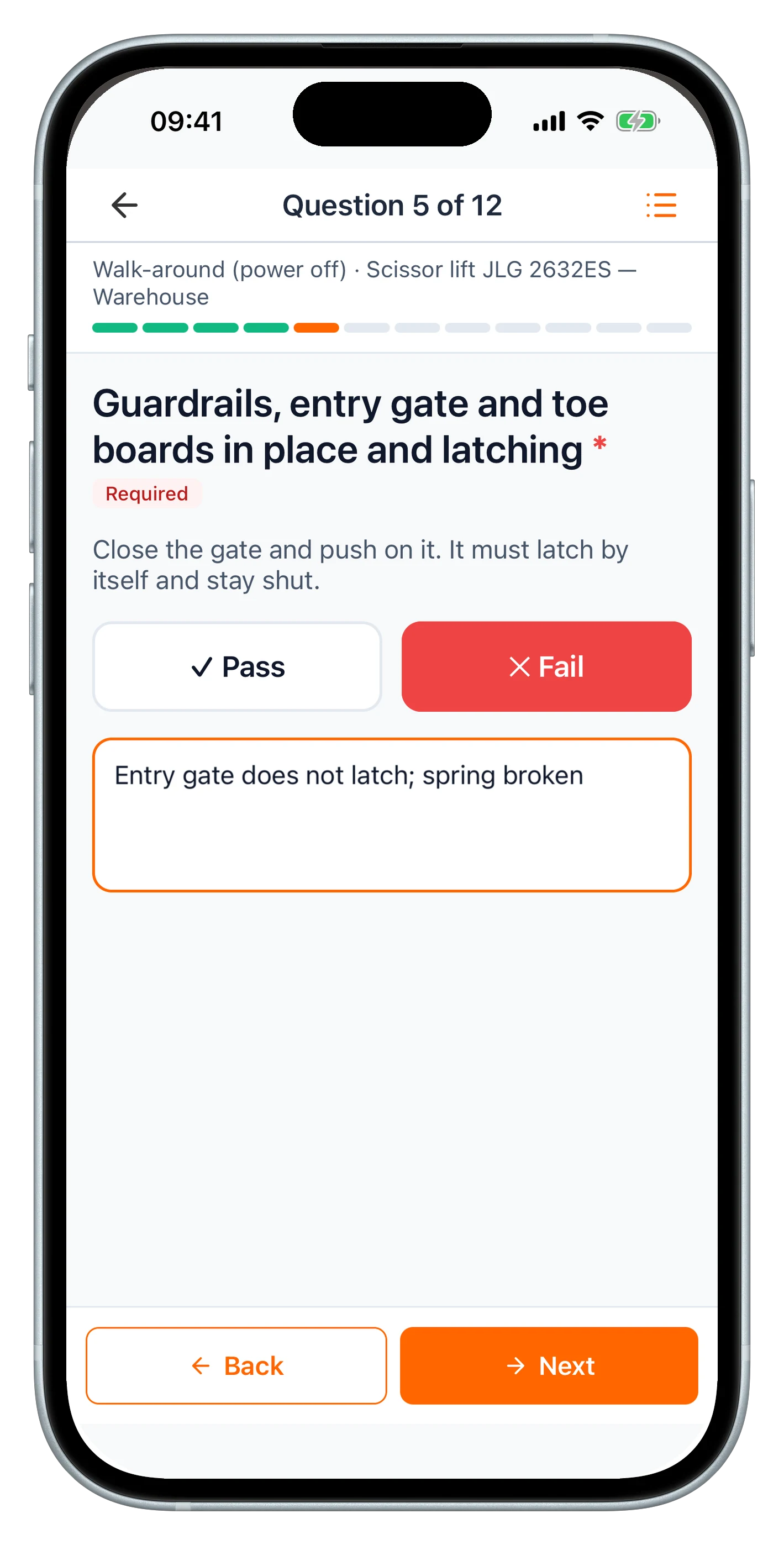
| Pre-start checklistThe template prints a weekly sheet per lift. UNIO24 runs your checklist on the operator's phone. | Partial | Yes |
| Photos of the damageThe broken gate or the leaking hose, attached to the check. | No | Yes |
| Defects and due dates | ||
| Keep a defective lift tagged outThe register shows DO NOT USE from the log. UNIO24 records the defect and can turn it into a repair work order. | Partial | Yes |
| Frequent and annual inspection datesBoth track them. UNIO24 also schedules the next inspection. | Partial | Yes |
| Data & reliability | ||
| Owned and rented lifts across sitesA shared file gets overwritten. UNIO24 handles simultaneous users and sites. | Partial | Yes |
| Full history per liftEvery check, defect, repair and inspection kept on the lift | Partial | Yes |
| Full support | 0/ 6 | 6/ 6 |
Frequently Asked Questions
About aerial lift inspections and the template
Is the aerial lift inspection checklist free?
Yes. No cost, no subscription, no card. Enter your name and email and the Excel file downloads instantly.
Is a scissor lift checklist different from a boom lift checklist?
Mostly the same: tires, hydraulics, structure, guardrails and gate, controls, emergency stops and alarms. Scissor lifts add pothole guards and the scissor stack; booms add the turntable, jib, boom sections and the anchor points for fall protection in the basket. The pre-start sheet covers both, and you leave out the rows that do not apply.
Do I need to inspect a rented scissor lift?
Yes. The rental company is responsible for the frequent and annual inspections and shows the dates on a decal, but your operators still do the pre-start check every shift. Add rentals to the register with their decal dates so the register flags a lift whose frequent inspection runs out while it is on your site.
How often does an aerial lift need to be inspected?
Before each shift by the operator; every three months or 150 hours, whichever comes first, by a qualified mechanic (the frequent inspection); and once a year by a qualified mechanic (the annual inspection). The template runs the frequent and annual clocks per lift; the pre-start check is the weekly printable sheet.
Who can do the frequent and annual inspections?
A qualified mechanic who knows that make and model, often from the dealer or rental company. The operator does the pre-start check but not these. Record the mechanic's name in the Inspection Log, and keep the signed report in the lift's file.
What happens when the pre-start check fails?
The lift is tagged Do Not Use and not used until a qualified person repairs it, for any defect in controls, brakes, guardrails, the gate, the tilt alarm or the emergency stop. Log the FAIL; the register shows DO NOT USE until you enter the repair date.
More inspection templates for work at height
The same register idea, applied to the rest of the gear on site.
Safety Harness Inspection Checklist
Pre-use checks, a defect log and competent-person inspection dates for fall protection.
Read more: Safety Harness Inspection Checklist
Scaffold Inspection Checklist
Shift inspections, a tag status per scaffold and a log of defects to fix.
Read more: Scaffold Inspection Checklist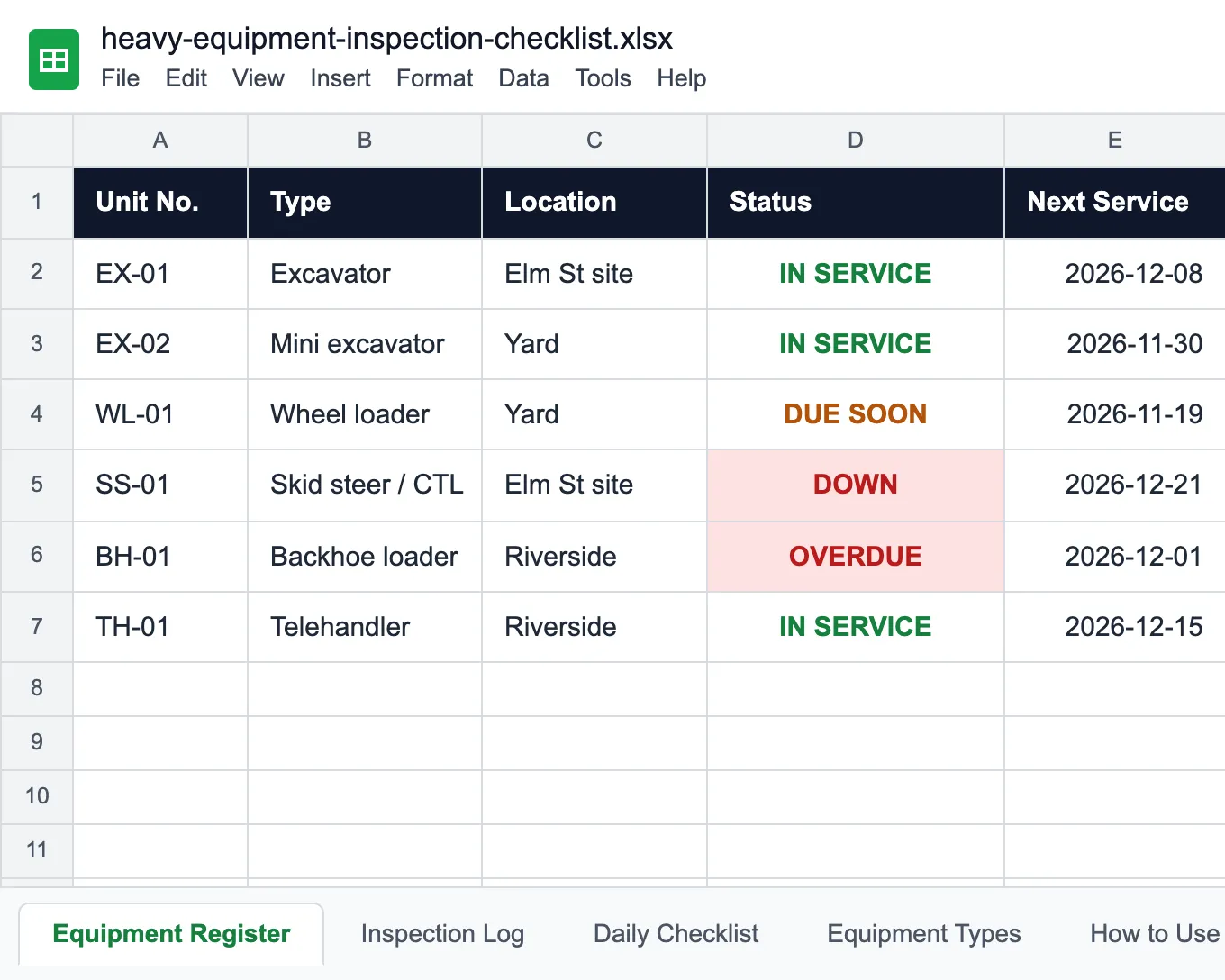
Heavy Equipment Inspection Checklist
Daily pre-start checks, a defect log and service dates for excavators, loaders and skid steers.
Read more: Heavy Equipment Inspection Checklist