Free Safety Harness Inspection Checklist for Excel
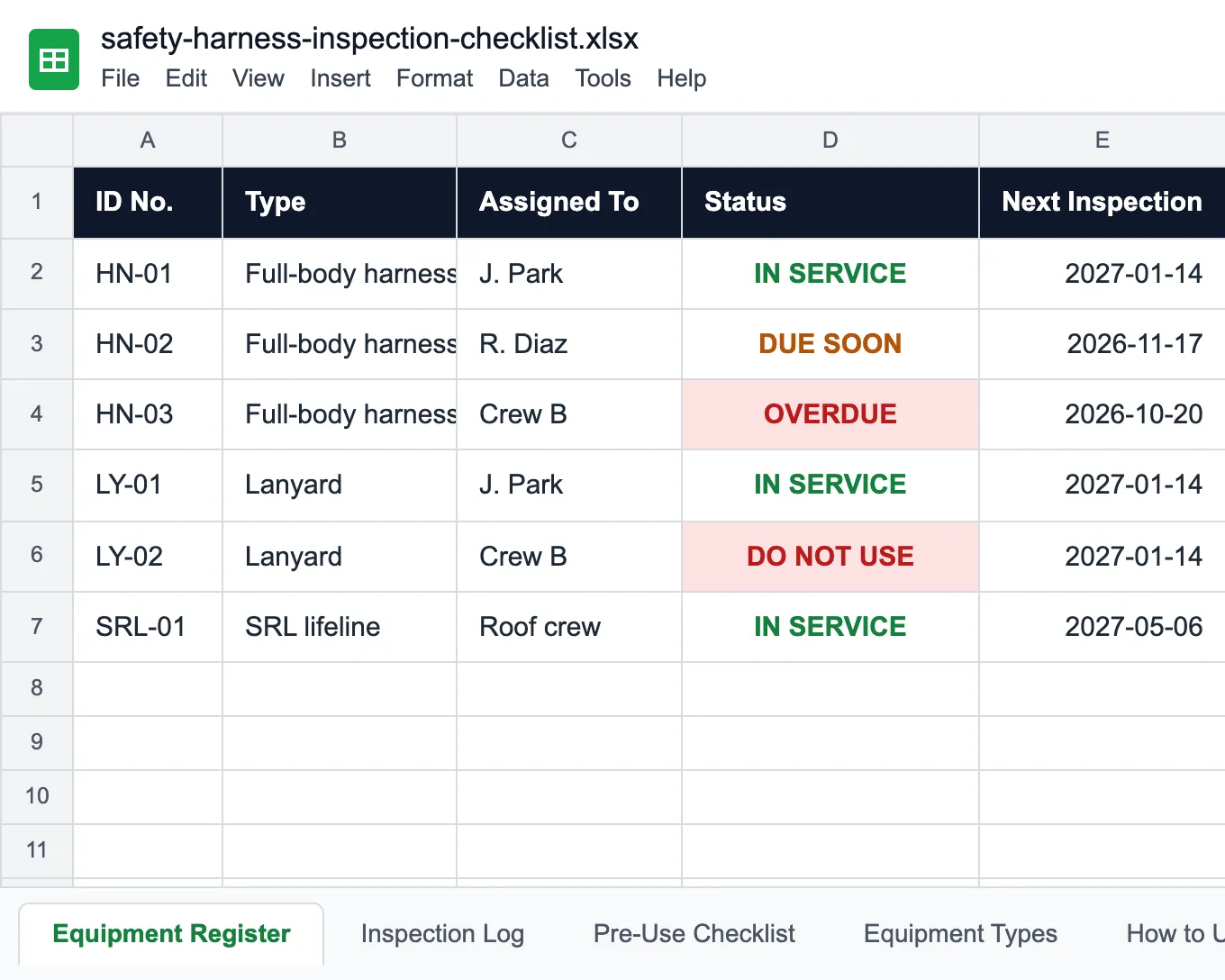
A weekly pre-use checklist the wearer ticks before each shift, plus the log and register behind it: a harness, lanyard or lifeline with a reported defect stays DO NOT USE until it is resolved, and the competent-person inspection shows OVERDUE or DUE SOON. Works in Microsoft Excel and Google Sheets.
What a safety harness inspection covers
A safety harness inspection checklist is a fall protection equipment inspection checklist for the gear a worker wears: the harness, the lanyard or self-retracting lifeline that ties it off, and the connectors. Fall protection gets two kinds of inspection. The wearer checks the harness and the lanyard or lifeline before each use, by eye and by hand. A competent person, someone trained to spot what the wearer misses, inspects the same equipment at set intervals and records it. Workplace safety rules require the check before use and require equipment that is damaged, or that has arrested a fall, to be taken out of service. How often the documented inspection happens is set by your program and the manufacturer; once a year is the common minimum, more often for heavy use, welding, chemicals or outdoor work.
The Pre-Use Checklist prints one sheet per harness per week, a column per day:
- Labels and history: labels present and legible, no fall indicator showing, competent-person inspection up to date.
- Harness: webbing free of cuts, frays, burns, chemical damage and fading; stitching complete; D-rings and metal parts free of cracks and corrosion; buckles and adjusters holding; keepers in place.
- Lanyard or lifeline: webbing or rope sound, energy absorber pack closed, a self-retracting lifeline that pulls out, retracts and locks when jerked, snap hooks and carabiners that self-close and self-lock.
- Before going up: a suitable anchorage and a rescue plan the crew knows.
A ticked sheet shows someone looked. It cannot stop a harness with a cut strap from going back on the hook. So the workbook keeps the record behind it:
Inspection Log. One row per competent-person inspection or failed pre-use check, with PASS or FAIL. A FAIL stays an OPEN DEFECT until you enter the date it was resolved: retired, replaced or cleared by the competent person. Damaged fall protection is not repaired in the field.
Equipment Register. One row per harness, lanyard or lifeline, with the worker or crew it is assigned to, make and model, serial number and size. It reads the log, shows DO NOT USE while a defect is open, and runs the inspection clock per type from the Equipment Types tab (12 months for every type, editable). Status reads OVERDUE when the inspection is late or was never logged, DUE SOON two weeks before, and IN SERVICE otherwise.
For ladders and scaffolds, use the ladder inspection checklist and the scaffold inspection checklist.
Who uses a safety harness inspection checklist
The wearer does the daily check. The safety officer needs the rest.
Construction contractors
Harnesses and lanyards shared between crews on roofs, steel and leading edges.
Roofing companies
Self-retracting lifelines and anchors that move from roof to roof.
Utilities and telecom
Climbing and positioning gear for pole, tower and line work.
Warehouses and manufacturing
Fall protection for aerial lifts, mezzanines and rack maintenance.
Facilities maintenance
Roof access, rooftop units and window work done by in-house teams.
Safety officers
Inspection dates, tagged-out gear and retirements across every crew.
Before you fill it in
The harness with the cut strap is back on the hook.
Try UNIO24 to automate harness inspections.
Try UNIO24 FreeA spreadsheet goes out of date within days, and keeping it current takes someone's time every day. UNIO24 automates that work: each inspection and defect updates the harness's record as it happens.
| Capability | Free Template | UNIO24 FreeRecommended for crews at height |
|---|---|---|
| Inspections | ||
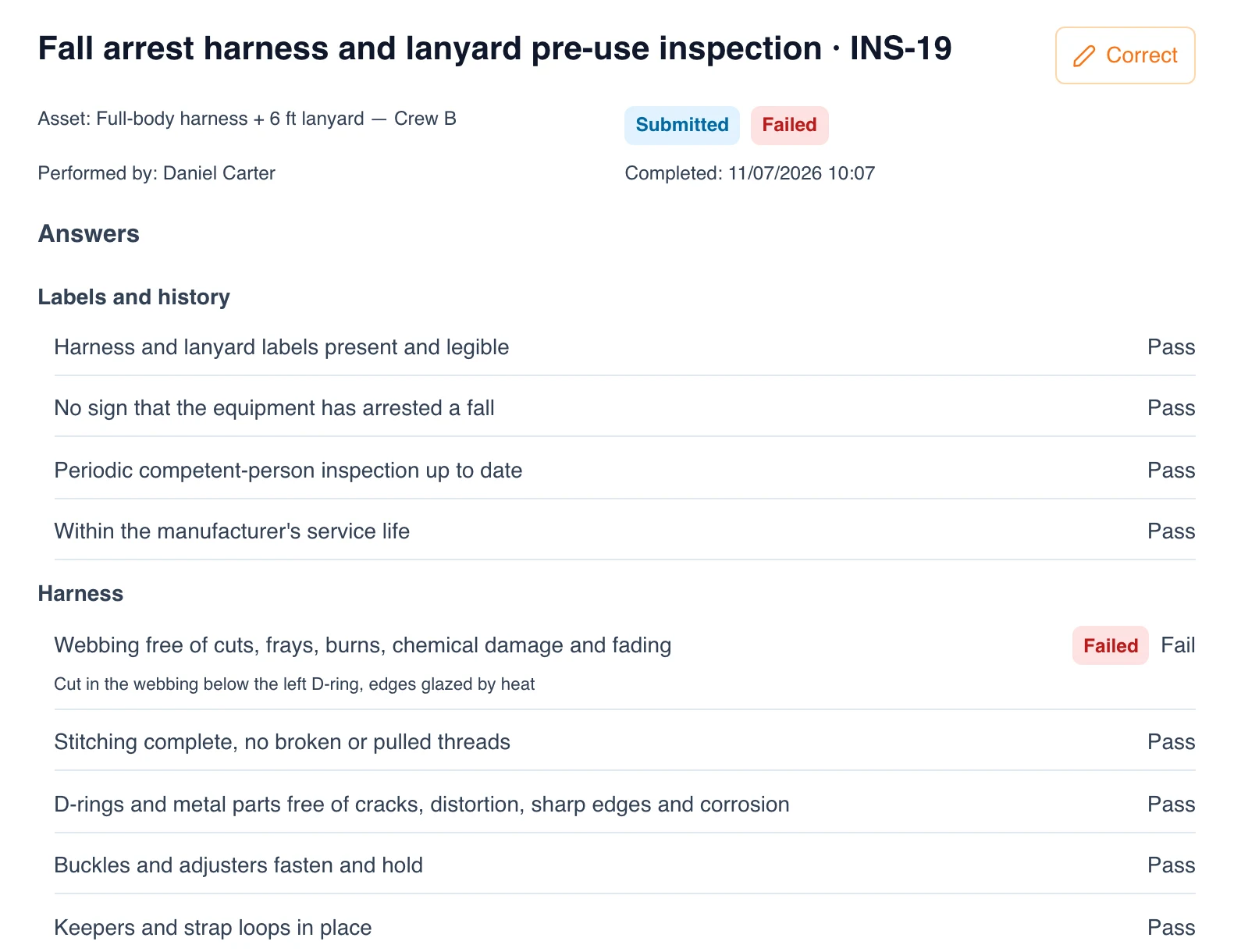
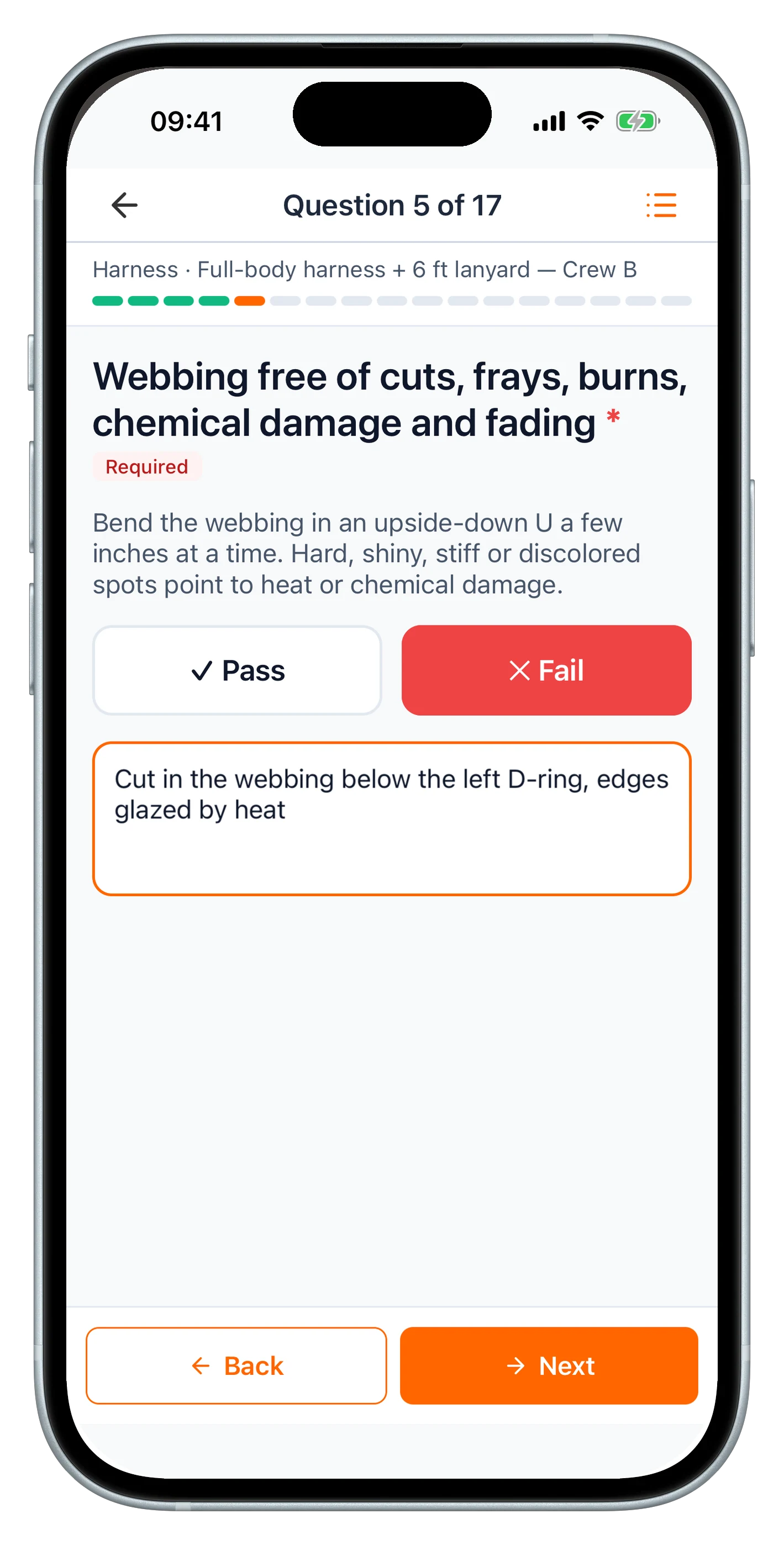
| Harness pre-use checklistThe template prints a weekly sheet per harness. UNIO24 runs a ready-made harness and lanyard template on the worker's phone. | Partial | Yes |
| Photos of the damageThe cut strap or the opened absorber pack, attached to the inspection. | No | Yes |
| Defects and due dates | ||
| Keep damaged gear out of useThe register shows DO NOT USE from the log. UNIO24 records the defect against the harness until it is resolved. | Partial | Yes |
| Competent-person inspection datesBoth track them. UNIO24 also schedules the next inspection. | Partial | Yes |
| Data & reliability | ||
| Many crews and sites at onceA shared file gets overwritten. UNIO24 handles simultaneous users. | Partial | Yes |
| Full history per harnessEvery inspection, defect and retirement kept on the harness | Partial | Yes |
| Full support | 0/ 6 | 6/ 6 |
Frequently Asked Questions
About harness inspections and the template
Is the safety harness inspection checklist free?
Yes. No cost, no subscription, no card. Enter your name and email and the Excel file downloads instantly.
Who counts as a competent person for harness inspections?
Someone your company has designated who can identify hazards in the fall protection system and has the authority to take equipment out of service. In practice it is a safety officer, a trained supervisor or a qualified outside inspector who knows the manufacturer's inspection criteria. The wearer's pre-use check does not replace this inspection.
Does a harness have an expiration date?
It depends on the maker. Some give a fixed service life from the date of manufacture or first use; others rely on inspection alone and retire the harness when it fails. Read the label and the manual, write the retirement date in the register Notes, and treat the label date as the limit even if the harness looks fine.
How often should a safety harness be inspected?
By the wearer before each use, and by a competent person at intervals your program and the manufacturer set, at least once a year in most programs and more often for heavy use or harsh conditions. Some self-retracting lifelines also need a factory service on a schedule in their manual. The template counts the competent-person interval per type, 12 months by default, and you change it on the Equipment Types tab.
When must a harness be removed from service?
When it has arrested a fall, when any item on the checklist fails (cut or burned webbing, broken stitching, a cracked or bent D-ring, a buckle that slips, a missing or unreadable label), or when it is past the service life the manufacturer gives. Tag it Do Not Use and send it to the competent person. Fall protection is retired or sent back to the maker, not repaired on site.
Can I use it for lanyards, lifelines and anchors too?
Yes. Each lanyard, self-retracting lifeline, rope grab and anchorage connector gets its own row and ID in the register, with its own inspection interval on the Equipment Types tab. The pre-use checklist has a lanyard and lifeline section, and the Lanyard / lifeline ID field ties the sheet to the harness it was used with.
More inspection templates for work at height
The same register idea, applied to the rest of the gear on site.
Ladder Inspection Checklist
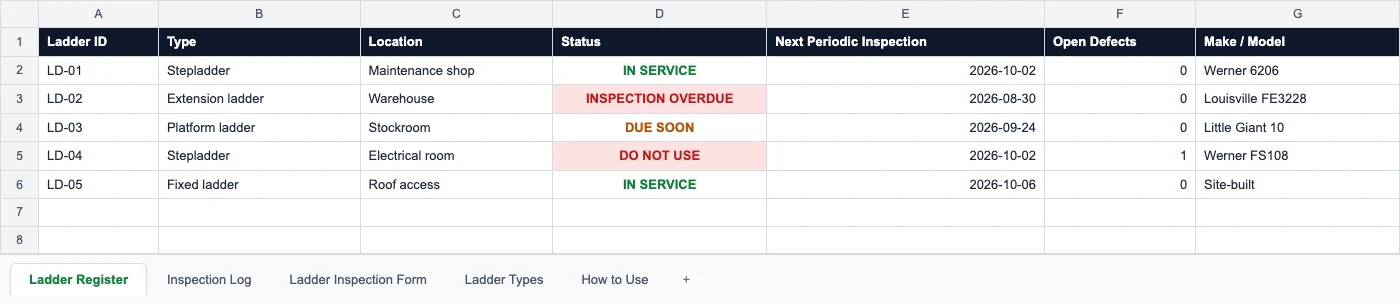
A yearly inspection form per ladder and a log that keeps a damaged ladder out of use.
Read more: Ladder Inspection Checklist
Scaffold Inspection Checklist
Shift inspections, a tag status per scaffold and a log of defects to fix.
Read more: Scaffold Inspection Checklist
Crane Inspection Checklist
Daily, frequent and periodic crane inspections with due dates per crane.
Read more: Crane Inspection Checklist