Free Job Safety Analysis Template for Excel
Break a job into steps, list what can go wrong at each one, score the risk before and after your controls, and print a one-page JSA the crew signs before work starts. A register keeps every JSA in one place and flags the ones that are overdue for review or still too risky. Works in Microsoft Excel and Google Sheets.
What a job safety analysis is, and what is in the file
A job safety analysis (JSA), also called a job hazard analysis (JHA), looks at one task the way the crew actually does it: step by step, asking at each step what could hurt someone and what stops it. It is done before the work, written down, and gone through with the people doing the job. The point is not the paperwork. It is the five minutes where somebody says "wait, the belt is still under tension when you pull the guard."
The workbook has five working tabs:
- JSA Steps: one row per hazard. The job step, what can go wrong, the hazard type, severity and likelihood scored 1–5, the controls, which level of the hierarchy they sit on, and the score again after controls. A step with three hazards gets three rows.
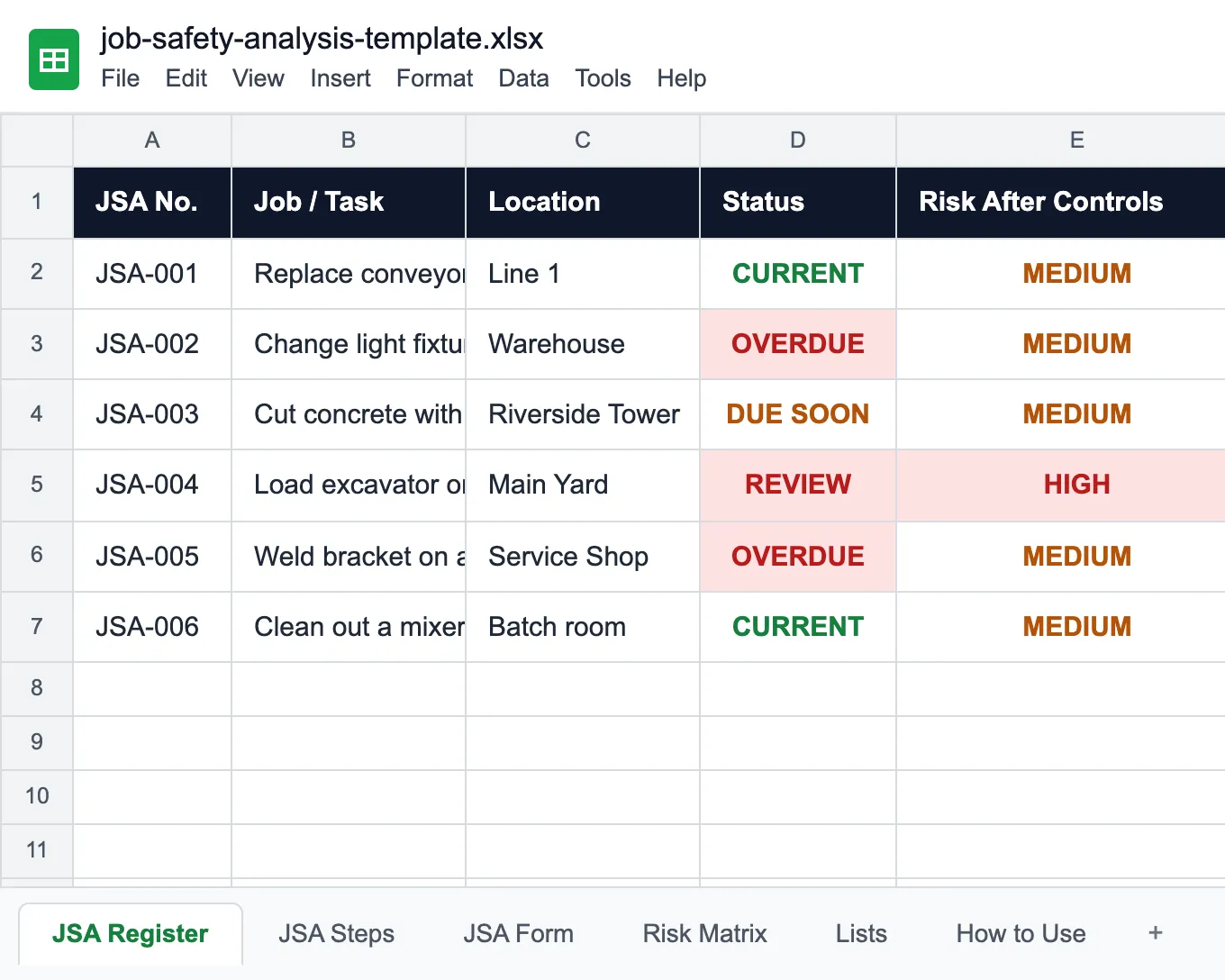
- JSA Register: one row per job. Risk After Controls and the number of steps fill in from the steps. Status reads REVIEW when you mark that the job changed, HIGH RISK while any step is still HIGH or EXTREME after controls, OVERDUE or DUE SOON by the review date, and CURRENT otherwise.
- JSA Form: the printable one-page form for the crew, with ten step rows, a PPE line and signatures. Pick the JSA number and the job and location fill in.
- Risk Matrix: the 5×5 scale and what each band means for whether work can start.
- Lists: the hazard types and the hierarchy of controls, which feed the dropdowns.
The sample rows are real jobs a maintenance and construction crew does every month: replacing a conveyor belt, changing light fixtures from a ladder, cutting concrete, loading an excavator onto a trailer, welding, cleaning out a mixer. Replace them with your own; the formulas carry on.
How to write a JSA that people actually use
Pick the job first, and pick it on purpose. Start with the ones that have hurt someone or nearly did, the ones done rarely enough that nobody remembers the tricky part, and anything new. A JSA for "general warehouse work" is useless; "replace the drive belt on conveyor 3" is not.
Then watch the job, or walk through it with someone who does it, and write the steps in order. Six to ten steps is usually right. If you are at twenty, the steps are too small; at three, you are hiding the hazards inside them.
For each step, write what can go wrong as something that happens to a person: "fingers caught between belt and pulley," not "pinch point." Score how bad it would be and how likely it is, 1 to 5 each. Then write the controls, and be honest about which kind they are. Eliminating the hazard or engineering it out beats a rule, and a rule beats PPE. The Control Type column makes that visible, which is the quickest way to spot a JSA that is all gloves and "be careful."
Score again with the controls in place. If anything is still HIGH or EXTREME, the job does not start yet. Go back up the hierarchy.
Last, go through it with the crew before the work, not after. The form has signature lines for a reason, and the best changes to a JSA usually come from the person who has done the job a hundred times and knows which step the write-up got wrong.
Review it once a year, and straight away after an incident, a near miss, new equipment or a new method. That is what the "Job Changed Since Review?" column is for. For the machines in those jobs, the lockout tagout procedure template covers the isolation steps a JSA should point to rather than repeat.
Who uses a job safety analysis template
Anywhere a job has steps that can hurt someone if they are done in the wrong order.
Construction crews
Cutting, lifting, working at height and moving equipment on site.
Maintenance teams
Belt changes, motor swaps and repairs on live production equipment.
Manufacturing plants
Changeovers, cleaning and clearing jams on presses and lines.
Utilities and field service
Jobs in vaults, on poles and at customer sites with new hazards every day.
Warehouses and logistics
Loading, racking work and anything near forklifts and docks.
Safety managers
Which jobs have a JSA, which are due for review and which still carry a high risk.
| Capability | Free Template | UNIO24 FreeRecommended for crews |
|---|---|---|
| Before the job | ||
| Pre-job safety checkThe template prints the form. UNIO24 runs a check you set up once on a phone at the job. | Partial | Yes |
| Photos from the jobThe guard, the isolation point or the trench as it looked, attached to the record. | No | Yes |
| After the job | ||
| Failed items followed upThe register flags jobs to review. UNIO24 keeps a failed item open against the equipment until it is fixed. | Partial | Yes |
| History per piece of equipmentEvery check, repair and document kept on the equipment the job was done on | No | Yes |
| Data & reliability | ||
| Many crews and sites at onceA shared file gets overwritten. UNIO24 handles simultaneous users. | Partial | Yes |
| Full support | 0/ 5 | 5/ 5 |
Frequently Asked Questions
About job safety analysis and the template
Is the job safety analysis template free?
Yes. No cost, no subscription, no card. Enter your name and email and the Excel file downloads instantly.
What are the steps of a job safety analysis?
Pick the job, break it into the steps in the order they are done, list what can go wrong at each step, score the risk, decide the controls starting with the most effective, score the risk again, and go through it with the crew before work starts. Review it after any change or incident.
How do you rate risk on a JSA?
Score severity (how bad the harm would be) and likelihood (how likely it is) from 1 to 5 and multiply them. In the template 1–4 is LOW, 5–9 MEDIUM, 10–16 HIGH and 20–25 EXTREME. Score once before controls and once after; work does not start while a step is still HIGH or EXTREME.
How often should a JSA be reviewed?
Once a year as a default, and straight away when the job changes: new equipment, a new method, a new crew, or after an incident or near miss. Set the review interval per job in the register; high-risk work often gets six months.
What is the difference between a JSA and a JHA?
Nothing in practice. Job safety analysis and job hazard analysis are two names for the same method: break the job into steps, find the hazards in each, decide the controls. Some companies use one name, some the other; the template works for both.
Which jobs need a JSA first?
The ones with injuries or near misses behind them, the ones where a mistake could kill or maim, new jobs, and jobs done so rarely that nobody remembers the awkward part. Routine low-risk work can wait. A register of twenty good JSAs beats two hundred copied ones.
What is the hierarchy of controls?
The order in which controls work best: eliminate the hazard, substitute something less dangerous, engineer people away from it (guards, interlocks, extraction), change how people work (procedures, permits, spotters), and last, PPE. The Control Type column records which one each control is, so a JSA that relies only on PPE stands out.
More safety templates
For the hazards a JSA points to.
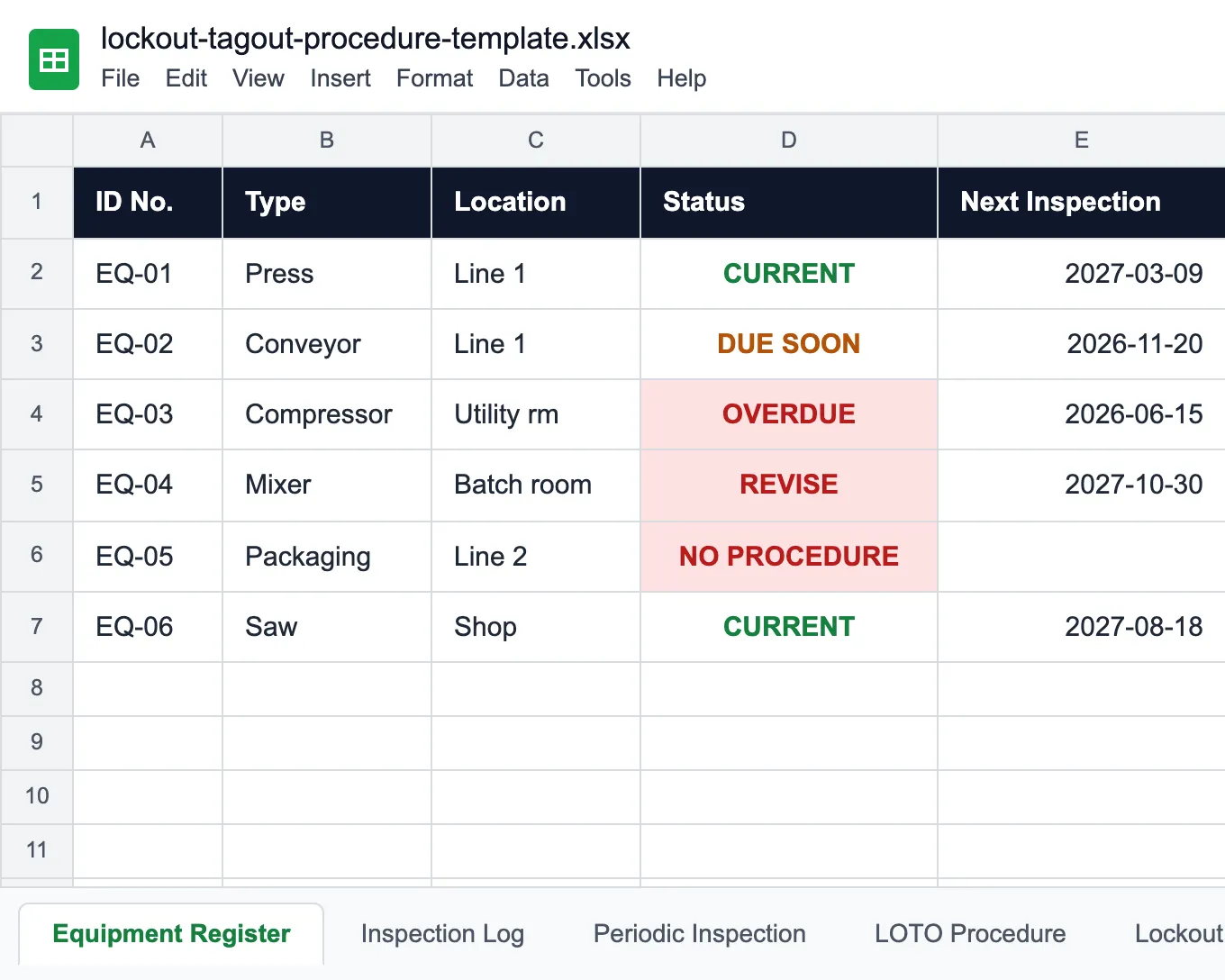
Lockout Tagout Procedure Template
Machine-specific LOTO procedures, a lockout log and the yearly inspection.
Read more: Lockout Tagout Procedure Template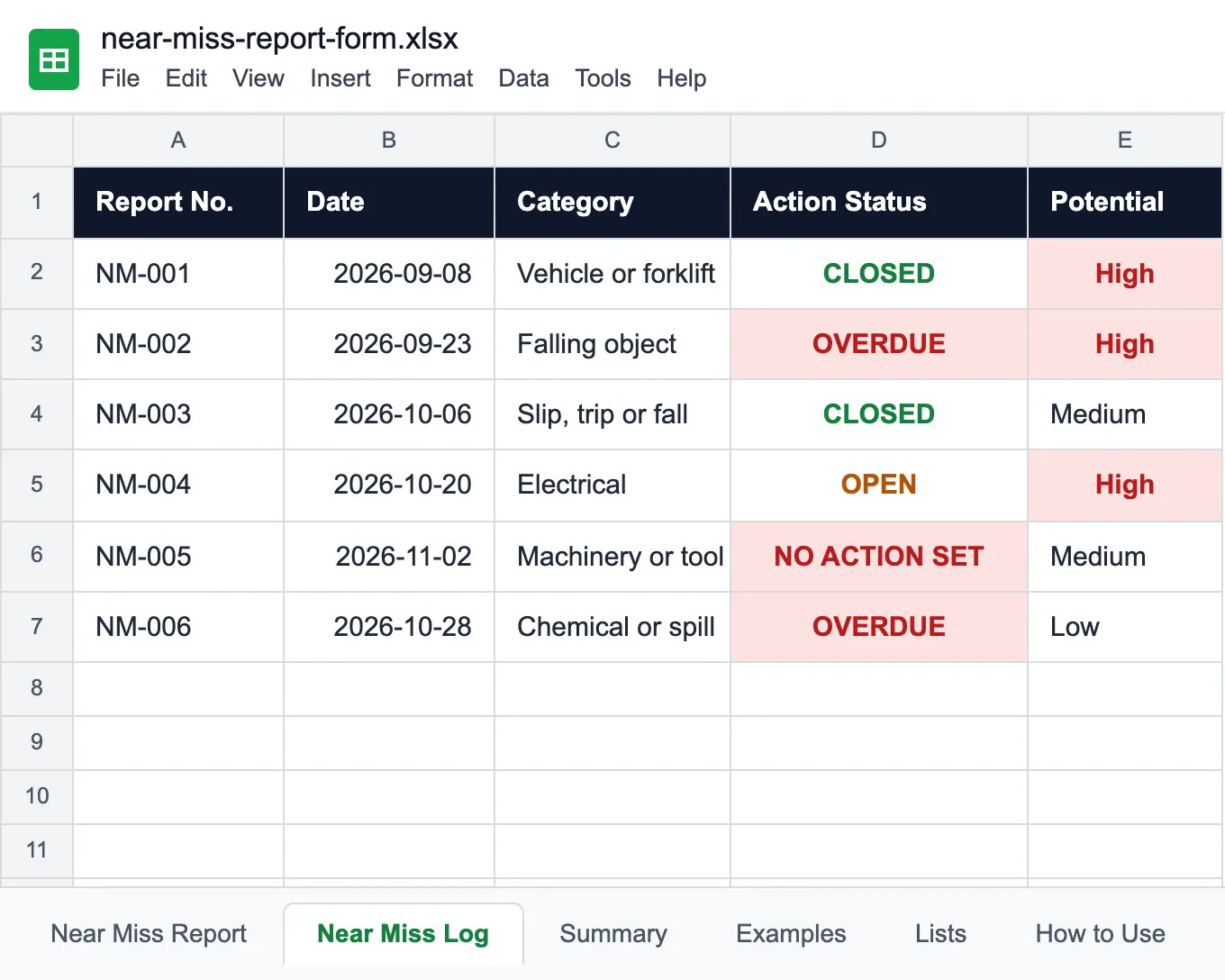
Near Miss Report Form
A one-page near miss report and a log that follows every fix to closure.
Read more: Near Miss Report Form
Incident Report Template
Report an injury or damage and track the corrective actions.
Read more: Incident Report Template